伺
Character Story & Explanation
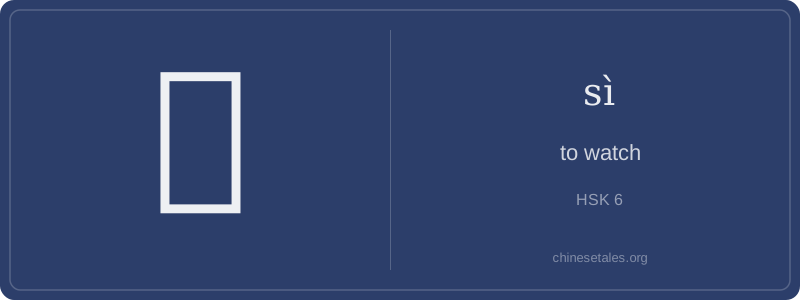
The earliest form of 伺 appears in bronze inscriptions as a compound: the radical 亻 (person) paired with 司 (sī), which itself originally depicted a hand holding a ceremonial vessel — symbolizing authority, management, and ritual oversight. In 伺, that ‘managing person’ evolved into someone *attending to* or *overseeing* a situation — not passively watching, but actively monitoring with responsibility. The modern 7-stroke shape stabilizes by the Han dynasty: 亻 + 司, where the four dots in 司’s bottom (in older forms) simplify into the horizontal stroke and dot we see today — a visual shorthand for meticulous, focused attention.
By the Warring States period, 伺 appears in texts like the *Zuo Zhuan*, describing officials ‘observing enemy movements to gauge weakness’ — always implying discretion and motive. In Tang poetry, it gains poetic nuance: Du Fu uses 伺 in lines about scholars ‘watching the shifting clouds’ not for weather, but for omens — blending surveillance with cosmological sensitivity. The character’s visual economy (just 7 strokes!) belies its conceptual weight: one small person, one authoritative glyph — together, they embody the ancient art of waiting *with eyes open and mind poised*.
At its core, 伺 (sì) isn’t just ‘to watch’ — it’s *watching with intent*, often quietly, patiently, and with a purpose: surveillance, waiting for an opening, or observing behavior to gain advantage. Unlike the neutral 看 (kàn) or the curious 观 (guān), 伺 carries a subtle charge of strategic attention — think a spy, a scholar studying rites, or a cat crouched before a mouse hole. It’s never casual; it’s always *purposeful observation*.
Grammatically, 伺 is almost always transitive and appears in formal or literary contexts — rarely in daily speech. You’ll find it in compounds like 伺机 (sì jī, 'to wait for an opportunity') or 伺察 (sì chá, 'to observe closely'), but almost never as a standalone verb in modern spoken Chinese. Learners mistakenly use it like 看 or 观 — e.g., *‘我伺他’* — which sounds archaic or even sinister. Instead, it pairs with abstract objects: 伺机、伺隙、伺便 ('wait for a chance/opportunity/convenient moment').
Culturally, 伺 reflects a deep-rooted Chinese appreciation for timing (时机), patience, and indirect action — values embedded in Sun Tzu’s Art of War and classical statecraft. Its rarity in speech makes it a linguistic ‘stealth word’: when it does appear, it signals gravity, strategy, or quiet vigilance — never boredom or idle glancing. Misusing it risks sounding either overly dramatic or suspiciously covert.