侈
Character Story & Explanation
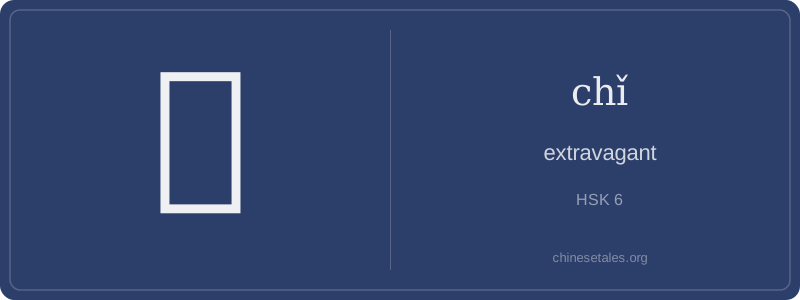
The earliest form of 侈 appears in bronze inscriptions as a combination of 人 (person) and 多 (many, later stylized into 丿+厶). In oracle bone script, it wasn’t yet standardized, but by the Warring States period, scribes carved it with a clear left-side 亻 (human radical) and right-side 口+厶 — where 口 suggested 'speech' or 'mouth', and 厶 (a closed loop) evoked 'selfish enclosure' or 'excessive accumulation'. Over centuries, the 口 shrank and merged with the 厶 into today’s compact 㐌 shape — eight clean strokes: two for 亻, then six forming the angular, slightly top-heavy right component.
This visual logic shaped its meaning: a person (亻) overflowing with self-centered abundance (the compressed, looping 口+厶). By the Han dynasty, 侈 was already entrenched in texts like the *Book of Han* to criticize imperial extravagance. Mencius famously warned, '俭,德之共也;侈,恶之大也' ('Frugality is the source of virtue; extravagance is the greatest evil'). The character’s tight, almost constricted right side visually mirrors how excess *constricts* moral clarity — a brilliant stroke-level metaphor that’s survived over two millennia.
At its core, 侈 (chǐ) isn’t just ‘extravagant’ — it’s *excess with attitude*. Think of it as the raised eyebrow of Chinese adjectives: it carries quiet moral judgment, implying wastefulness, immoderation, or even arrogance in display. Unlike neutral terms like 奢华 (shēhuá, 'luxury'), 侈 almost always appears in critical contexts — describing spending, rhetoric, or ambition that crosses a line of propriety. It’s rarely used alone; you’ll see it bound tightly in compounds like 奢侈 (shēchǐ) or 侈靡 (chǐmí), or as a verb meaning ‘to exaggerate’ (e.g., 侈言 — 'to boast extravagantly').
Grammatically, 侈 is mostly adjectival or nominal, but watch out: learners often misplace it as a standalone predicate adjective ('This is 侈') — a classic error. Native speakers don’t say *这个很侈*; they say *这个太奢侈了* or *这是侈靡之风*. It thrives in formal, literary, or journalistic registers — you’ll find it in editorials about consumerism or classical essays warning against decadence. Its tone (third tone) also trips people up: chǐ sounds sharp and clipped, mirroring its semantic bite.
Culturally, 侈 echoes Confucian ideals of moderation (中庸, zhōngyōng). In ancient texts like the *Zuo Zhuan*, rulers who built lavish palaces were condemned for 侈 — not for wealth itself, but for violating social harmony through disproportionate display. Modern learners sometimes soften it into mere ‘luxury’, missing its built-in disapproval. Remember: 侈 doesn’t describe a Rolex — it describes wearing *three* Rolexes to a rice-farming cooperative meeting.