侮
Character Story & Explanation
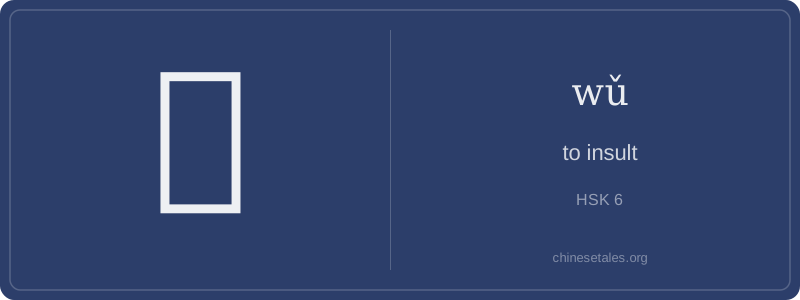
The earliest form of 侮 appears in bronze inscriptions around 1000 BCE: a figure (人) beside a hand holding a weapon-like glyph — possibly a stylized whip or scepter — suggesting authority enforcing submission. Over centuries, the weapon morphed into the ‘每’ component (originally depicting a woman’s headdress + grain, later phonetic), while the radical 亻 (person) remained anchored on the left. By the Han dynasty, the character stabilized into its modern nine-stroke shape: 亻+每 — visually encoding ‘a person acting out dominance through ritualized repetition’ (the ‘every’-ness of ‘每’ implying habitual condescension).
This visual logic shaped its meaning: 侮 wasn’t just ‘say something rude’ — it was performative, systemic disrespect. In the Mencius, 侮 appears in the famous line ‘无侮鳏寡’ (‘Do not insult widows and orphans’), framing it as a failure of benevolent governance. Later, in Tang legal codes, ‘侮’ distinguished verbal degradation from mere ‘injury’ — if you mocked a magistrate’s robe, you 侮; if you broke his teacup, you damaged property. The ‘每’ component subtly reinforces this: contempt isn’t a one-off jab, but a repeated, normalized act — making 侮 feel chillingly bureaucratic in its cruelty.
Think of 侮 (wǔ) as Chinese’s linguistic equivalent of a sharp, deliberate elbow to the ribs — not random violence, but a calculated, face-to-face slight that wounds dignity more than flesh. Unlike generic 'insult' words like 辱 (rǔ) or 骂 (mà), 侮 carries moral gravity: it implies contemptuous superiority, often from power to vulnerability — a boss belittling an employee, a scholar mocking a peasant in classical texts. It’s rarely used alone; you’ll almost always see it in compounds (e.g., 欺侮, 侮辱) or with verbs like ‘to suffer’ (受侮) or ‘to commit’ (施侮).
Grammatically, 侮 is nearly always transitive and formal — you won’t hear it in casual WeChat banter. Learners mistakenly try to use it like English ‘insult’ in active, colloquial sentences (e.g., *‘He 侮 me yesterday’*). Wrong! It demands structure: subject + [verb] + 侮 + object (e.g., 他公然侮辱我), or appears as a noun in passive constructions (如:遭受侮辱). Also, it’s almost never reduplicated or used in imperative mood — unlike 骂, you’d never say ‘别侮!’
Culturally, 侮 triggers Confucian alarm bells: Mencius called disrespecting others a sign of losing one’s ‘humane heart’ (仁心), and in imperial law, insulting elders or officials carried harsher penalties than physical assault. Modern usage still echoes this — calling someone ‘不尊重’ is mild; saying they ‘欺侮弱者’ is a serious moral indictment. A common learner trap? Overusing it where 轻视 (qīngshì, ‘to look down on’) or 冷嘲热讽 (lěngcháo rèfèng, ‘to mock sarcastically’) would sound more natural and less archaic.