侠
Character Story & Explanation
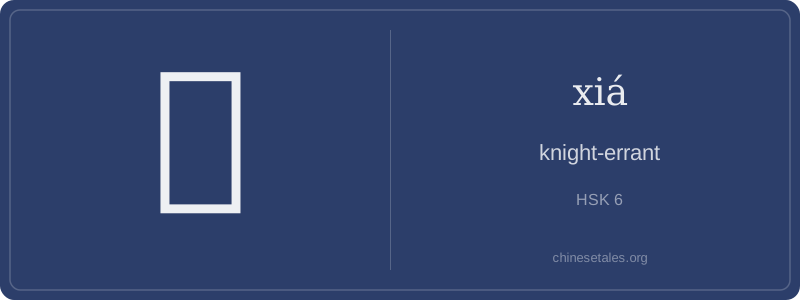
The earliest form of 侠 appears in seal script (c. 3rd century BCE), combining 亻 (person) with 朿 — a pictograph of thorny branches, symbolizing sharpness, resistance, and defense. Over centuries, 朿 morphed into 夾 (jiā), which itself depicts two hands gripping something (two radicals flanking 一), reinforcing the idea of *clamping down on injustice*. By the Han dynasty, the structure stabilized: left-side 亻 (8 strokes total) + right-side 夾 — no longer about thorns, but about *active, two-handed moral enforcement*.
This visual evolution mirrors its philosophical journey: Confucius dismissed early xia as ‘disorderly’, yet Sima Qian’s *Records of the Grand Historian* gave them a dedicated chapter — praising assassins like Jing Ke not for violence, but for sacrificing life for righteous cause. The character’s shape — a person *grasping* principle — became inseparable from its meaning: moral agency so fierce it overrides hierarchy. In Ming-Qing fiction, 侠 crystallized as the wandering swordsman who answers only to Heaven’s justice — a living embodiment of the character’s stroke-by-stroke demand: *hold fast, stand firm, act*.
At its heart, 侠 (xiá) isn’t just ‘knight-errant’ — it’s the moral lightning rod of Chinese culture: a lone figure who bends rules *to uphold justice*, not break them. Think less armored noble, more morally uncompromising wanderer with a sword and a code. The radical 亻 (rénbàng, ‘person’) anchors it as human action, while the right side 朿 (cì, originally ‘thorn’ or ‘prickle’) evolved into 夾 (jiā, ‘to grip/clamp’) — hinting at *holding fast* to principle, even under pressure. This isn’t passive virtue; it’s active, often rebellious, righteousness.
Grammatically, 侠 is almost never used alone in modern speech — you won’t say ‘he is 侠’. Instead, it thrives in compounds (xiákè, xiáyì) or as a noun modifier: ‘a chivalrous person’ (xiázhě), ‘chivalrous spirit’ (xiáqì). Learners often mistakenly treat it like an adjective (e.g., *xiá de rén*), but it doesn’t take 的 that way — it’s a bound noun root, like ‘-hood’ or ‘-ism’ in English. You say 他有侠气 (tā yǒu xiáqì), not *他很侠*.
Culturally, 侠 carries immense weight — from Warring States philosophers debating whether xia was virtuous or lawless, to Jin Yong’s novels where xiákè choose loyalty over empire. A common pitfall? Translating it as ‘hero’ — too vague and Western. A hero saves; a 侠 *judges*, *avenges*, and *redefines justice* when institutions fail. It’s why ‘xia’ appears in brand names (e.g., Xiaomi’s ‘Mi’ echoes ‘miào’ but taps into youthful, agile idealism — a subtle nod to modern 侠-ethos).