俯
Character Story & Explanation
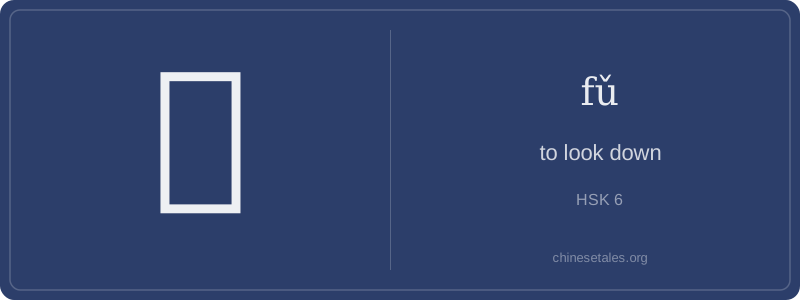
The earliest form of 俯 appears in bronze inscriptions as a composite: left side 亻 (a person), right side 付 (fù), which itself evolved from a hand placing something onto a platform — suggesting ‘hand delivering downward’. By the seal script era, the right-hand component simplified into 甫 (fǔ), retaining the ‘downward placement’ idea. The ten strokes crystallized into today’s form: two for the person radical (亻), then eight strokes forming 付 — with the final dot and捺 (nà) stroke evoking a head tilting decisively downward, like a nod or bow.
This visual logic deepened over time. In the *Zuo Zhuan*, 俯 described rulers ‘looking down’ to assess their people’s welfare — merging physical posture with moral responsibility. Later, in Tang poetry, Du Fu wrote ‘俯视但一气’ (fǔshì dàn yī qì) — ‘looking down, there was only mist’ — turning 俯 into a lens for both literal landscape and existential perspective. Its enduring power lies in how the character’s very structure enacts its meaning: a person (亻) literally leaning into the act of giving attention downward — not away, not up, but purposefully, groundedly, downward.
At its heart, 俯 (fǔ) is about deliberate downward orientation—not just of the eyes, but of posture, attitude, and even power. It’s not passive glancing down like 看 (kàn), nor hurried bending like 弯 (wān); it’s a conscious, often respectful or introspective lowering—of the head, gaze, or body. Think of bowing to honor someone, scanning terrain from a hilltop, or humbly reflecting inward. That ‘deliberateness’ is key: you 俯 when you choose to submit, examine closely, or yield.
Grammatically, 俯 functions mainly as a verb in compound verbs or literary constructions. You rarely say *‘I 俯’* alone—it’s almost always paired: 俯瞰 (fǔkàn, ‘overlook’), 俯首 (fǔshǒu, ‘bow one’s head’), or in fixed phrases like 俯拾即是 (fǔshí jíshì, ‘so abundant they’re easily picked up’). Learners often mistakenly use it as a standalone action verb (e.g., *‘他俯了’*)—but that’s unnatural; Chinese prefers aspect markers or compounds: 俯下身 (fǔ xià shēn, ‘bend down’) or 俯视 (fǔshì, ‘look down on’).
Culturally, 俯 carries subtle weight: in classical texts, it signals humility before elders or heaven (e.g., Confucius ‘俯而思之’ — ‘bowed his head and reflected’), while in modern usage, 俯视 can imply condescension (e.g., ‘以高人一等的姿态俯视别人’). A common trap? Confusing it with 伏 (fú, ‘to crouch/hide’) — same sound, totally different shape and meaning. Also, note: 俯 is almost never used in spoken Mandarin without a complement — it’s a literary anchor, not a conversational workhorse.