倔
Character Story & Explanation
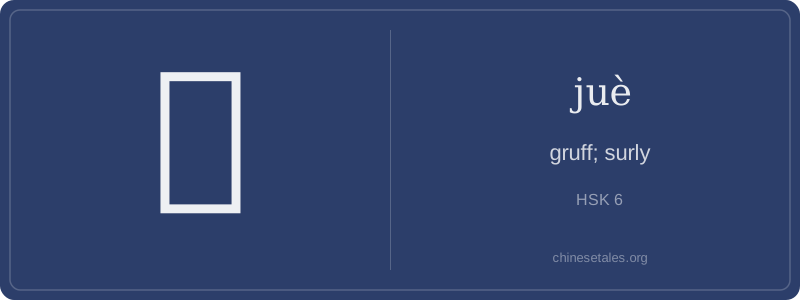
The earliest trace of 倔 appears not as a standalone character, but as part of the ancient variant 崛 (jué, ‘to rise up’) — where the right side ‘屈’ (qū, ‘to bend, yield’) was originally drawn with a kneeling figure (尸) under a bent arm (虍-like element), visually shouting ‘body forced down!’ Over centuries, the kneeling figure simplified, the ‘arm’ became 出, and the left radical 亻 (person) was added to specify *human* inflexibility — crystallizing into today’s 倔: a person (亻) who refuses to bend (屈 → simplified to the top-right strokes resembling ‘出’ + ‘卩’).
This visual logic held firm: by the Tang dynasty, 倔 was already used in poetry to describe mountain peaks ‘stubbornly piercing clouds’ (e.g., Du Fu’s drafts), then naturally extended to people whose wills stood rigid against pressure. The character’s shape itself mirrors its meaning — the sharp, angular strokes of the right component feel like elbows jutting out, shoulders squared. Even the stroke order ends with a decisive downward flick (the final 乚), as if drawing a line in the sand — a detail scribes unconsciously echoed for over a thousand years.
At its core, 倔 (juè) isn’t just ‘gruff’ — it’s the linguistic fingerprint of a person who folds their arms *before you’ve even finished speaking*. It captures that prickly, unyielding stubbornness that borders on emotional defensiveness: not rational resistance, but visceral, almost physical refusal to bend — in tone, posture, or opinion. Think of a teenager slamming a door not because they disagree, but because being told to close it *feels like an invasion*.
Grammatically, 倔 is almost always used as an adjective modifying a person or temperament — never as a verb or standalone noun. You’ll hear it in phrases like 他脾气很倔 (tā píqì hěn juè), but never *‘juè le’* (no verb form!) or *‘yī gè juè’* (no noun use). Learners often mistakenly try to use it like 苦 (bitter) or 忙 (busy), but 倔 only lives in human disposition — and crucially, it’s almost always paired with a concrete behavioral cue: a tightened jaw, averted eyes, clipped speech. Its tone (juè, fourth tone) is itself abrupt — no glide, no softening, just a hard stop.
Culturally, 倔 carries quiet judgment: it’s rarely complimentary. Calling someone 倔 implies social friction — they’re difficult to persuade, resistant to harmony (hé), and may disrupt group cohesion. Interestingly, it’s more commonly applied to children, elders, or artists than to peers — suggesting it’s tolerated (even romanticized) in certain life stages or roles, but still marked as ‘non-ideal’ behavior in Confucian-influenced contexts. A classic learner mistake? Writing or pronouncing it as jué (like 觉) — which shifts meaning entirely into ‘awaken’ or ‘perceive’. That one tone mark is the difference between sulking and enlightenment.