倘
Character Story & Explanation
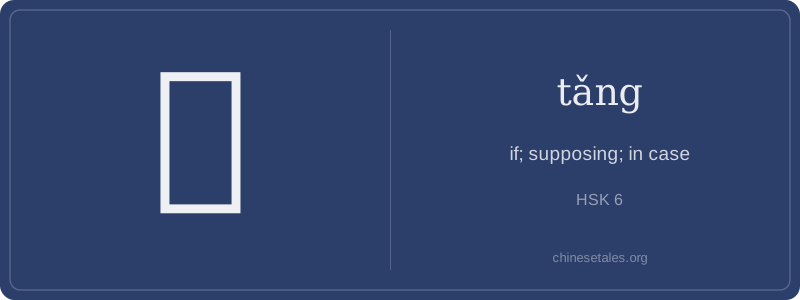
追溯字形,倘最初不见于甲骨文,而是在小篆中清晰浮现:左为‘人’旁(亻),右为‘尚’——一个象形与声符兼备的组合。‘尚’本义为‘向上、崇尚’(篆书像屋下有口,表尊崇之言),加‘人’旁后,整体构形暗示‘人向上设想’或‘人立于未然之境’。楷化过程中,‘尚’的上部‘⺌’(点、撇、点)与下部‘冋’(变形为口+丨)逐渐规整,最终定型为今日10画的平衡结构:亻(2画)+ 尚(8画)—— the human element literally supporting the upward-looking idea.
意义演变极具哲思:先秦文献中极少单用,至汉魏六朝渐成书面条件连词,尤其受骈文影响,追求音节对仗与语义含蓄。《文心雕龙》用‘倘’引出思辨假设,如‘倘使才高而不学,则如金玉其外’;唐宋以后,它 became the go-to character for elegant contingency — not brute causality, but refined possibility. Visually, the upright 亻 beside the layered ‘shàng’ (still echoing ‘upward aspiration’) mirrors how Chinese thinkers frame hypotheses: not as cold logic gates, but as human postures — standing respectfully before the unknown.
At its heart, 倘 (tǎng) isn’t just a dry ‘if’ — it’s the linguistic equivalent of leaning in and whispering, ‘Let’s imagine something *just slightly beyond reality*.’ It carries a gentle, literary weight: less like the blunt, everyday 如果 (rúguǒ), and more like saying ‘supposing…’ or ‘were one to…’ in English — thoughtful, hypothetical, often tinged with modesty or caution. You’ll rarely hear it in casual chats; it lives in essays, formal speeches, classical allusions, and polite proposals.
Grammatically, 倘 almost always appears at the beginning of a conditional clause, followed by 便 (biàn), 乃 (nǎi), or more commonly, just a comma before the main clause — e.g., 倘有疑问,欢迎提出。It never stands alone as a sentence starter like 如果 can; it demands elegance in structure. Learners often mistakenly use it like a drop-in synonym for 如果 — but that’s like using ‘verily’ instead of ‘really’ at a coffee shop: technically correct, wildly out of place.
Culturally, 倘 reflects a Confucian-tinged preference for softening assertions — hedging possibility rather than stating condition outright. Its rarity in speech signals humility: you’re not declaring a scenario, you’re tentatively inviting it. A classic learner trap? Overusing it in writing to sound ‘more Chinese,’ only to come across as stilted or archaic. Remember: 倘 is the velvet rope at the door of hypotheticals — respected, but not for every party.