倦
Character Story & Explanation
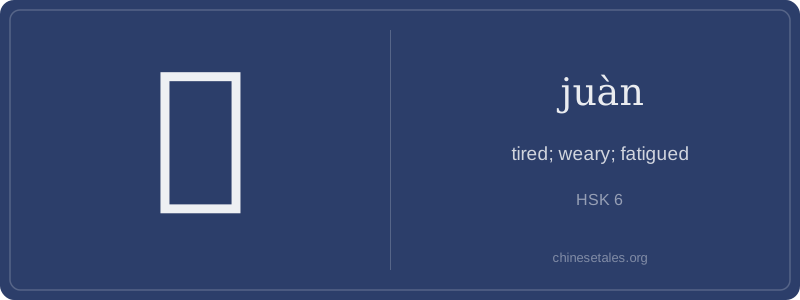
The earliest form of 倦 appears in Warring States bamboo slips, not as a pictograph but as a phonosemantic compound: the left side 亻 (rén bàng) signals ‘person’, while the right side 卷 (juǎn) — originally depicting a rolled-up scroll — served both sound and meaning. In bronze script, 卷 looked like a hand twisting a rope or rolling a textile; over centuries, its strokes simplified into today’s 卷 (4+6 strokes), retaining the sense of ‘coiling, winding, exhausting effort’. The full character thus visually suggests a person whose energy has been ‘rolled up’ and depleted — not collapsed, but wound down like a spent spring.
This ‘wound-down’ metaphor crystallized in classical texts: in the Book of Rites, 倦 describes ritual fatigue — not bodily soreness, but spiritual dimming after repeated ceremonial performance. By the Song dynasty, poets like Su Shi used 倦 to convey philosophical weariness with worldly striving (e.g., ‘宦游无倦’ — ‘no weariness in official service’, implying unwavering commitment). Notice how the radical 亻 anchors it in human experience, while 卷’s coiling shape echoes the cyclical, draining nature of prolonged labor — a visual etymology that still pulses in every modern usage.
Imagine a scholar in the Tang Dynasty, ink-stained fingers trembling after copying sutras for twelve hours straight — not just physically drained, but mentally hollowed out, his spirit fraying at the edges. That’s 倦 (juàn): not mere sleepiness like 困 (kùn), but a deep, soul-weary exhaustion that settles into your bones and blunts your will. It’s the fatigue of sustained effort — intellectual, emotional, or moral — often carrying a quiet note of resignation or disillusionment.
Grammatically, 倦 rarely stands alone; it’s almost always part of compounds (e.g., 疲倦, 倦怠) or appears after verbs to indicate exhaustion *from* an activity: ‘工作了一整天,他感到筋疲力尽,甚至对最爱的茶也生出倦意。’ (After working all day, he felt utterly spent—even weary of his favorite tea.) Crucially, it’s not used predicatively like ‘I’m tired’ (we say 我很累); instead, it modifies nouns (倦容, 倦眼) or pairs with verbs like 感到, 显得, or 生出 to express the *onset* or *manifestation* of weariness.
Culturally, 倦 carries subtle Daoist and Chan Buddhist resonance — think of the famous line from the Zhuangzi: ‘形劳而不休则弊,精用而不已则劳,劳则竭。’ (When form labors without rest, it wears out; when essence is used without cease, it fatigues — and fatigue leads to depletion.) Learners often misapply it as a casual synonym for ‘tired’ in speech — a red flag! Using 倦 in everyday chat (e.g., ‘我今天很倦’) sounds archaic or overly literary. Reserve it for writing, formal reflection, or poetic nuance — where fatigue isn’t just physical, but existential.