俭
Character Story & Explanation
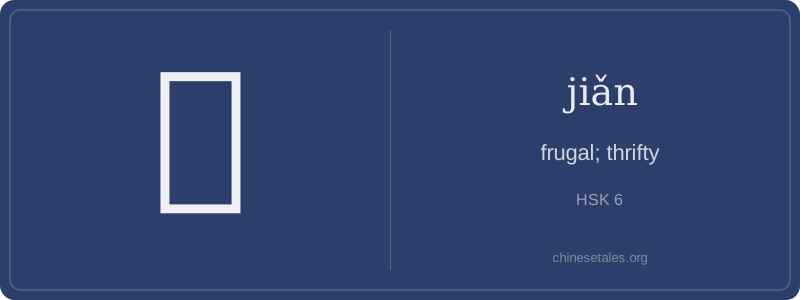
The earliest form of 俭 appears in bronze inscriptions as a compound: the left side was 人 (rén, ‘person’), and the right was 佥 (qiān), which originally depicted multiple mouths (口) under a roof (亼), symbolizing collective agreement or consensus. Over time, 人 simplified to 亻 (the ‘person’ radical), and 佥 evolved into its modern shape — three ‘mouths’ stacked vertically ( + 一 + 口), now stylized as 奸 without the female radical. So visually, 俭 began as ‘a person embodying collective agreement’ — suggesting harmony through shared restraint, not individual denial.
This idea crystallized in classical texts: Mencius wrote that ‘the superior man practices frugality to nurture virtue’ (《孟子》), and the Dao De Jing praised ‘knowing contentment’ (知足) as foundational to 俭. Interestingly, the character’s structure mirrors its philosophy — the 亻 radical grounds it in human conduct, while the right side, though abstracted, still echoes communal voice (口 ×3), reminding us that frugality is never solitary; it’s a social covenant. Even today, when elders urge children to be 俭, they’re invoking ancestral wisdom encoded in those nine strokes — not scarcity, but sovereignty over desire.
Think of 俭 (jiǎn) as the Chinese cousin of the Greek concept of *sophrosyne* — not just 'frugality', but a deeply respected virtue of self-restraint, balance, and mindful stewardship. In English, 'thrifty' often carries a faint whiff of stinginess or penny-pinching; in Chinese, 俭 is warm, dignified, and socially admired — it’s how Confucius praised Yan Hui, his most virtuous disciple, who ‘lived in a humble lane, subsisted on coarse rice and plain water, yet remained joyful’ (Analects 6.11). This isn’t austerity for survival; it’s elegance in restraint.
Grammatically, 俭 functions almost exclusively as an adjective — never a verb — and rarely stands alone. You’ll almost always see it paired: in compounds like 勤俭 (qín jiǎn, ‘diligent and frugal’) or as part of set phrases like 俭以养德 (jiǎn yǐ yǎng dé, ‘frugality nurtures virtue’). Learners often mistakenly try to say ‘I am frugal’ with 我很俭 — but that’s unnatural; instead, use 我很节俭 (wǒ hěn jié jiǎn) or describe behavior: 他生活很俭朴 (tā shēnghuó hěn jiǎn pǔ).
Culturally, 俭 is inseparable from sustainability and moral cultivation — it’s one of the ‘Eight Virtues’ (八德) and appears in state campaigns like 光盘行动 (‘Clean Plate Campaign’). A common error? Using 俭 where 节 (jié, ‘to conserve’) belongs — you don’t ‘save electricity’ with 俭 (×节电 is correct); 俭 describes *character*, not actions. It’s less about what you do, and more about who you are when no one’s watching.