拟
Character Story & Explanation
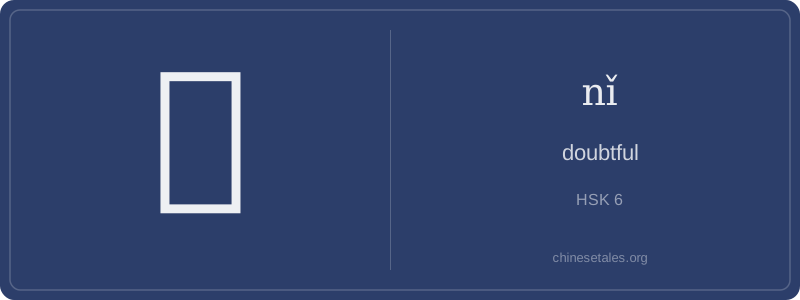
The earliest form of 拟 appears on Warring States bamboo slips as 扌 + 以 — no 'nǐ' sound component yet. The left side 扌 (hand) signals action; the right side 以 was both phonetic (ancient pronunciation close to *ŋrəʔ*) and semantic: 以 meant 'to use, to employ'. So the original idea was 'to employ [something] as a stand-in' — visualized as a hand reaching out to place one object *in the role of* another. Over time, the 以 shape simplified and stabilized into today’s clean, angular right-hand component, while the hand radical retained its three-stroke form.
By the Han dynasty, 拟 had crystallized around the concept of *authoritative substitution*: Sima Qian used it in the *Shiji* to describe officials 'acting in the capacity of' ministers during crises. In classical poetry, it birthed 拟古 (nǐgǔ, 'imitating ancient style'), where poets didn’t copy — they *assumed the voice* of past masters. The stroke count (7) subtly echoes this duality: 3 strokes for 扌 (action), 4 for 以 (means/role) — a perfect balance of agency and method.
Think of 拟 (nǐ) not as 'doubtful' in the sense of hesitation — that’s a common mistranslation trap — but as 'acting *as if*' or 'standing in for': like an understudy stepping into a Broadway role, or a digital twin mirroring a physical machine. Its core feeling is *intentional resemblance*, not uncertainty. In English, we’d say 'so-called', 'quasi-', or 'in the capacity of' — it’s about provisional, functional equivalence.
Grammatically, 拟 is almost never used alone. It’s the engine behind formal verbs: 拟定 (nǐdìng, 'to draft [a law]'), 拟议 (nǐyì, 'to propose [a plan]'), and especially 拟人 (nǐrén, 'personification'). Notice the pattern: 扌 (hand radical) + 以 (yǐ, 'by means of') → literally 'to handle something *by means of* likeness'. So when you see 拟 in a compound, ask: 'What is being temporarily stood in for — and by whose authority?'
Culturally, 拟 carries quiet gravitas: it’s the character used in official documents ('The committee *proposes* to amend Article 5'), literary devices ('the river *smiles*'), and even AI ethics debates ('human-*like* reasoning'). Learners often misread it as 'maybe' or 'perhaps' (confusing it with 似 or 可能), but 拟 implies deliberate, structured substitution — not vagueness. It’s certainty dressed as flexibility.