凄
Character Story & Explanation
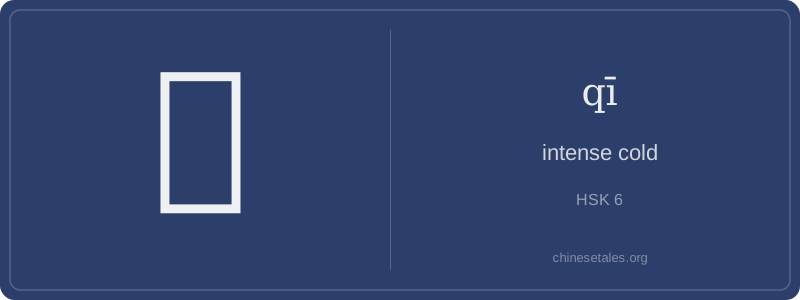
The earliest form of 凄 appears in bronze inscriptions as a compound pictograph: left side was 冫 (two ice crystals), representing cold; right side was 妻 (qī, 'wife'), but not as a person — rather, a stylized depiction of a woman with disheveled hair and bent posture, symbolizing vulnerability and exposure to harsh elements. Over centuries, the 'wife' component simplified into the modern 戚 (qī, 'grief, kinship'), preserving both sound and emotional weight. The ten strokes crystallized by the Han dynasty: two icy dots atop a tense, downward-slanting structure — visually echoing shivering shoulders.
This fusion wasn’t accidental: in ancient China, widows and exiled families were literally exposed to the elements — unsheltered, cold, and socially frozen. Thus, 凄 evolved from physical cold → emotional desolation → aesthetic austerity. By the Tang dynasty, poets like Li Bai used it to describe autumn winds that ‘cut like knives’ (秋风凄切); in Dream of the Red Chamber, it paints the abandoned garden’s decay — not just empty, but *coldly* empty. Its visual tension — ice + kinship-in-distress — makes it one of Chinese writing’s most emotionally charged thermal metaphors.
Think of 凄 (qī) as Chinese Gothic literature’s favorite adjective — not just 'cold', but the bone-deep, soul-chilling cold of a deserted abbey at midnight, or the silence after a tragedy. In English, we might say 'eerie' or 'desolate'; in Chinese, 凄 carries that same emotional frost: it’s the chill of abandonment, grief, or stark beauty stripped bare. It rarely stands alone — you’ll almost never hear someone say 'this is qī' — but appears in compounds like 凄凉 (qīliáng, 'bleak') or 凄惨 (qīcǎn, 'grim'), always amplifying sorrow with physical coldness.
Grammatically, 凄 is almost exclusively an attributive adjective (before nouns) or part of fixed four-character idioms (chengyu), like 凄风苦雨 (qī fēng kǔ yǔ — 'biting wind and bitter rain'). You won’t use it predicatively like 'It feels qī' — that would sound archaic or poetic. Learners often wrongly insert it into casual speech ('今天很凄'), but native speakers would say '今天很冷' or '气氛很压抑'. The character demands gravity — it’s Shakespearean, not Snapchat.
Culturally, 凄 evokes classical poetry’s aesthetic of *xiāo sè* (desolation), where cold isn’t meteorological but metaphysical — think Du Fu’s lines about ruined palaces and falling leaves. A common mistake is overusing it for 'sad'; while related, 悲 (bēi) is general sorrow, while 凄 implies cold-infused desolation. Also, watch the tone: qī (first tone), not qǐ (third) — mispronouncing it as 'qǐ' could accidentally conjure 'to rise' (起), turning 'a bleak dawn' into 'a rising dawn'!