凝
Character Story & Explanation
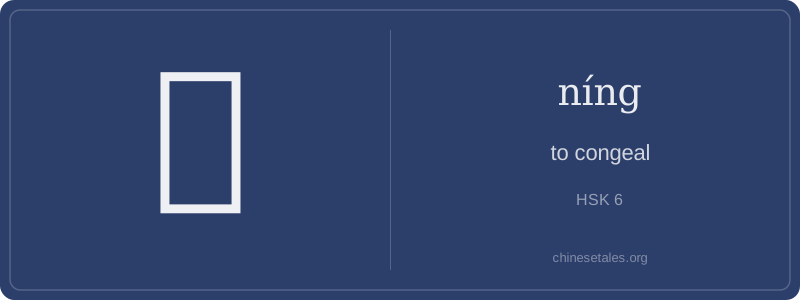
The earliest form of 凝 appears in Warring States bamboo texts as a combination of 冫 (ice) and 疑 (yí, ‘to doubt’ — originally a pictograph of a person hesitating, head tilted, holding a halberd). But here’s the twist: 疑 wasn’t borrowed for sound alone — its ancient meaning of ‘hesitation, suspension’ fused perfectly with 冫’s chill. Imagine frozen breath hanging mid-air, time suspended — that visual metaphor stuck. Over centuries, the top part simplified from 疑’s full form (with 矛 and 艮) into today’s 5-stroke upper component, while 冫 retained its two icy dots, now firmly anchoring the character’s cold, arresting essence.
This fusion of ‘ice’ + ‘hesitation’ gave 凝 its enduring duality: physical coagulation *and* mental/emotional fixation. In the Book of Songs, it describes frost clinging stubbornly to reeds; by the Tang dynasty, poets like Li Bai used it for eyes ‘凝望’ — not just looking, but gazing so deeply the world around fades. Even today, when someone says 他目光凝住, it doesn’t mean ‘his eyes stopped’ — it means ‘his attention seized and held, like mist freezing on glass’.
At its heart, 凝 isn’t just about ice hardening — it’s about *intentional stillness*. Think of breath fogging on a cold window: that moment when vapor pauses, gathers, and becomes visible — that’s 凝. It captures the transition from fluid to focused, from scattered to solidified — whether it’s steam condensing, attention locking onto something, or emotion thickening into silence. It’s deeply sensory and poetic, never casual.
Grammatically, 凝 is almost always transitive and used in formal or literary contexts — you *cause* something to congeal or concentrate. You don’t say ‘the soup 凝s’ (that’s more naturally 凝固 or 凝结); instead, you say ‘her gaze 凝 on the painting’ — implying active, sustained focus. It rarely appears as a standalone verb in speech; it shines in compound verbs like 凝视 (to gaze intently) or in descriptive phrases like 凝重的气氛 (an oppressive, heavy atmosphere). Learners often overuse it trying to sound ‘advanced’, but native speakers reserve it for moments charged with weight or quiet intensity.
Culturally, 凝 evokes classical restraint: the stillness before a decision, the gravity of unspoken grief, the hush before thunder. Mistake it for a generic ‘become solid’ and you’ll miss its emotional resonance — it’s not physics, it’s psychology made visible. And beware: it’s never used for food setting (like jelly), nor for abstract ‘focus’ without physical or perceptual anchoring (e.g., ‘I concentrated on math’ → 专心, not 凝).