凸
Character Story & Explanation
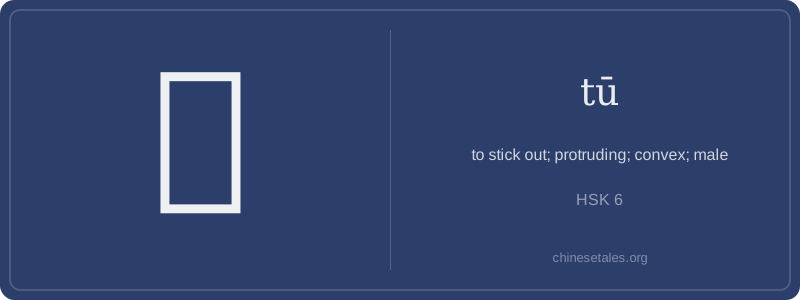
The earliest form of 凸 appears in bronze inscriptions as a bold, upward-thrusting arc — like a mountain peak drawn with one confident stroke — enclosed beneath two short horizontal lines suggesting a horizon or boundary. Over centuries, the arc simplified into a single curved stroke (the top dot and curve), while the base hardened into 凵, the ‘hollow’ radical — not because it’s hollow, but because ancient scribes used 凵 to frame *contours*, whether convex or concave. By the Han dynasty, the five-stroke structure stabilized: the dot (•), the curve (㇆), then the left vertical, right vertical, and closing horizontal of 凵 — a perfect visual metaphor: something pushing *against* containment.
This tension between containment and emergence shaped its meaning. In the Shuōwén Jiězì (121 CE), Xu Shen defined it as ‘shān gāo ér qǐ’ — ‘a mountain high and rising’, emphasizing vertical dominance over surrounding terrain. Unlike 平 (flat) or 圆 (round), 凸 isn’t about symmetry — it’s about asymmetry, rupture, and localized force. Its pairing with 凹 (concave) became canonical in Song-dynasty optics texts describing mirror surfaces, cementing its role as half of a fundamental geometric duality — a duality still taught in every Chinese physics classroom today.
Imagine you’re squinting at a cracked smartphone screen — right where the glass bulges upward like a tiny dome. That’s 凸 in action: not just ‘protruding’ as an abstract idea, but *viscerally* three-dimensional, almost tactile. In Chinese, 凸 is rarely used alone; it’s the quiet architect of shape — always paired (凸起, 凸面) or contrasted (凸 vs. 凹). It doesn’t describe intention or emotion; it describes physics on the page: a ridge on a map, a swollen vein on a temple, the raised logo on a credit card. Learners often misread it as ‘upward movement’ (like 起), but no — 凸 is pure static geometry: *already stuck out*, unchanging, unmoving.
Grammatically, 凸 behaves like an adjective or noun, never a verb — so you’ll never say ‘他凸了’ (‘He protruded!’). Instead, it appears in compound nouns (凸透镜), descriptive phrases (表面凸起), or technical terms (凸轮). Its most common usage? In engineering, optics, and design — think blueprints, CAD software, or lens specs. Even in literature, when used poetically (e.g., ‘山势凸兀’), it evokes stark, angular grandeur — not soft curves, but abrupt, almost defiant elevation.
Culturally, 凸 carries subtle gendered baggage: in classical medical texts and modern slang, it’s used euphemistically for male anatomy — a usage that’s clinical in textbooks but cheeky in internet memes. Learners stumble here by overgeneralizing: assuming 凸 = ‘male’ everywhere (it’s not — that meaning only appears in fixed, often humorous or technical contexts). Also, its radical 凵 (kǎn, ‘hollow’) is ironic — a ‘hollow’ radical framing something that *isn’t hollow*. That visual paradox is exactly why native speakers remember it: the character itself *sticks out* from the crowd.