凹
Character Story & Explanation
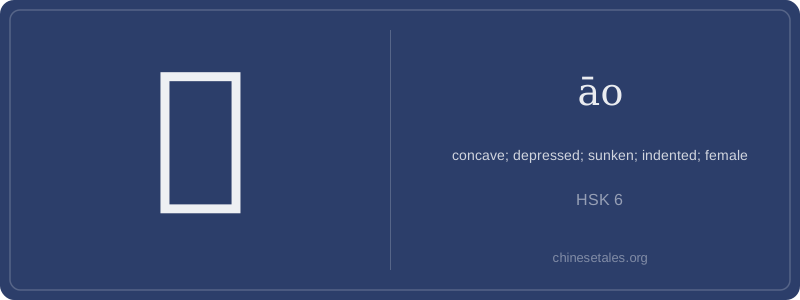
The earliest form of 凹 appears in bronze inscriptions as a simple pictograph: a downward-curving line cradled within two vertical strokes — like a shallow basin carved into stone. Over time, the top curve became the distinctive ‘mountain peak’-shaped stroke (⺄), while the two side strokes evolved into the radical 凵 (a container-like 'open mouth' shape), and the bottom horizontal stroke stabilized the base. By the seal script era, it had solidified into a five-stroke glyph where every element echoes containment and inward curvature — no accidental angles, only deliberate recession.
This visual logic drove its semantic evolution: from concrete topography (a natural depression in earth or rock) to abstract states (emotional ‘dips’, social ‘deficits’, or even anatomical references). In the Shuōwén Jiězì (100 CE), Xu Shen defined it as ‘deep and curved inward’, anchoring it in physical space. Later, poets like Du Fu used 凹 metaphorically — describing mountain gorges as ‘qīng shān xiōng yǒu qiū’ (green hills holding autumn in their concave folds), merging geology with feeling. Even today, its shape whispers ‘recess’ — a silent invitation to look inward, both literally and linguistically.
Think of 凹 (āo) as Chinese calligraphy’s version of a dip in a potato chip — instantly recognizable, deeply physical, and impossible to unsee once you know it. Its core meaning isn’t abstract: it’s tactile, spatial, and gravitational — describing any surface that caves *inward*, like a crater, a dimple, or the hollow of your cheek. Unlike English ‘concave’, which lives mostly in physics textbooks, 凹 is vividly alive in daily speech: you’ll hear it describing a dented car fender (车门凹了), a sunken floorboard (地板凹下去了), or even metaphorically — a ‘depressed’ mood (情绪凹了), especially among young netizens who borrow its visual punch for emotional shorthand.
Grammatically, 凹 behaves like an adjective but often appears bare — no ‘de’ (的) needed before nouns. You say 凹面镜 (concave mirror), not *凹的面镜. As a verb, it’s intransitive and often used with directional complements: 坑凹下去 (the pit sinks down) or 墙凹进去了 (the wall caves inward). Learners frequently misread it as yāo or āo with wrong tone — but here’s the key: it’s always first tone āo, and never used alone as a noun (unlike ‘concavity’ in English); it must modify or describe.
Culturally, 凹 carries subtle gendered resonance: in classical texts and modern slang alike, it’s occasionally used as a euphemism for ‘female’ — echoing the ancient conceptual link between receptivity, interiority, and femininity (think yin, the receptive principle). But beware: this usage is poetic or ironic, not literal — deploying it carelessly in formal contexts can sound bizarre or even offensive. And yes, its radical 凵 (kǎn) literally means ‘open mouth’ or ‘pit’ — a perfect visual anchor for its meaning.