刹
Character Story & Explanation
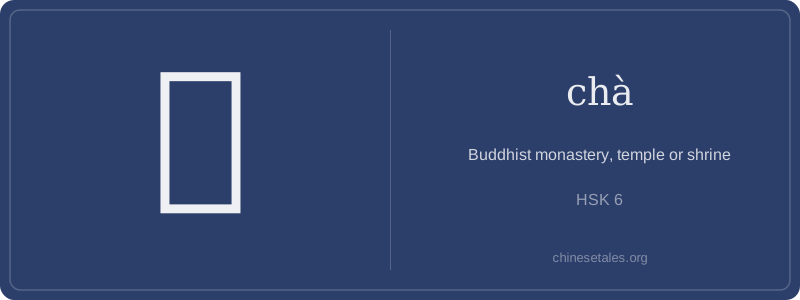
The earliest form of 刹 appears in seal script (around 3rd century BCE), where it combined two key elements: the left side 乂 (yì), originally a pictograph of crossed blades symbolizing ‘cutting’ or ‘order’, and the right side 刂 (dāo), the knife radical — not for violence, but as a phonetic anchor. Over centuries, 乂 simplified into the top part we see today (a crossbar over two short strokes), while 刂 remained unmistakably sharp and vertical. By the Han dynasty, the character had stabilized into its modern 8-stroke form — elegant, balanced, and quietly authoritative.
This visual ‘cutting’ element isn’t about destruction — it’s about precision and boundary-setting, reflecting how early Buddhist monasteries were conceived as sacred, delineated spaces: places where worldly chaos was ‘cut off’ to make room for enlightenment. The Sūtra of the Buddha’s Last Teachings (佛垂般涅槃略说教诫经) uses 刹 to describe the ‘pure land’ of monastic discipline, and Tang poets like Wang Wei wrote of ‘mountain mist drifting past the ancient 刹’ — each time, the character visually echoes the temple’s clean lines and disciplined silence.
At first glance, 刹 (chà) feels like a quiet, ancient word — not something you’d hear in daily chatter, but one that hums with temple bells and incense smoke. Its core meaning is ‘Buddhist monastery’ or ‘shrine’, but it’s rarely used alone; instead, it appears almost exclusively in literary, poetic, or formal compound words like 古刹 (gǔ chà, ‘ancient temple’) or 山刹 (shān chà, ‘mountain monastery’). Think of it as the ‘-tholos’ in ‘apothecary’ — archaic, precise, and deeply rooted in tradition.
Grammatically, 刹 functions only as a noun, always embedded in compounds — you’ll never say *‘this 刹’* or *‘a 刹’* on its own. Learners often mistakenly treat it like a standalone countable noun (e.g., *‘I visited three 刹’*), but native usage demands compounds: *gǔ chà*, *fó chà*, *shān chà*. It also carries no plural marker or measure word — you say 一座古刹 (yī zuò gǔ chà), not *三刹*. The radical 刂 (knife) might confuse beginners, but here it’s purely phonetic — no violence involved!
Culturally, 刹 evokes reverence and stillness — it’s the kind of word you’d find in Tang dynasty poetry or a stone stele at Mount Emei. A common slip is misreading it as shā (like in 刹车), but that’s a completely different character (same shape, different origin and tone) meaning ‘to brake’. Confusing the two is like mixing up ‘bass’ (the fish) and ‘bass’ (the instrument) — same spelling, worlds apart in meaning and context.