剔
Character Story & Explanation
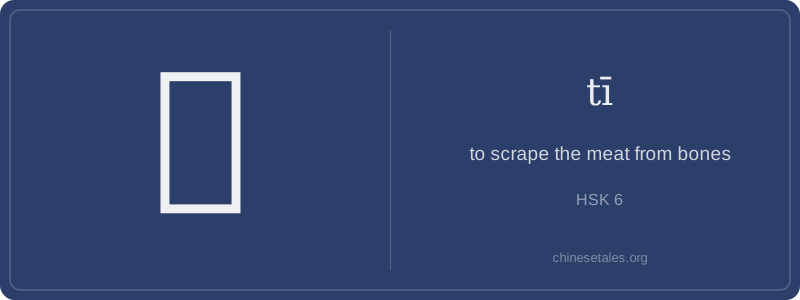
The earliest form of 剔 appears in bronze inscriptions around 1000 BCE: a pictograph combining a bone (骨, later simplified to 丰) and a sharp blade (刂). The original character depicted a hand holding a knife slicing *along* the surface of a bone — not hacking, but skimming. Over centuries, the bone element morphed into the top component 易 (yì), which originally resembled stacked bones (not ‘easy’!), while the right-hand 刂 radical remained unchanged — a visual promise of precision cutting.
By the Han dynasty, 剔 had shifted from literal bone-scraping to metaphorical refinement: Confucian scholars used it for ‘eliminating base desires’ (剔除私欲), and Tang poets wrote of moonlight 剔透 (tī tòu) — literally ‘scraped-through,’ meaning so clear it feels *carved* from light. This semantic expansion — from physical act to intellectual and aesthetic purification — cemented 剔 as a high-register character of discernment and rigor, never casual or crude.
Imagine a master chef in a Beijing courtyard restaurant, knife glinting as he deftly scrapes every shred of tender pork from the rib bone — not just removing meat, but revealing the clean, elegant architecture of the bone itself. That’s 剔 (tī): it’s not mere ‘removing’; it’s precise, intentional, often delicate extraction — like peeling a tangerine segment without breaking the pith, or editing a manuscript to delete only the fluff. It carries a quiet insistence on purity of form.
Grammatically, 剔 is almost always transitive and verb-only — you *must* specify what’s being scraped away: 剔骨 (tī gǔ), 剔牙 (tī yá), 剔除 (tī chú). You’ll never say ‘I’m 剔-ing’ alone — that’s ungrammatical, unlike English ‘I’m scraping.’ Also, note: while 剔除 means ‘to eliminate,’ it’s formal and bureaucratic (e.g., laws, data, flaws), never used for people — saying ‘剔除他’ sounds dehumanizing, like deleting a file. Learners often overuse it where 删 (shān) or 删除 (shānchú) would be more natural.
Culturally, 剔 reflects Chinese aesthetic values: refinement through removal — think of jade carving, where beauty emerges not from adding, but from meticulous subtraction. In classical texts, 剔 appears in medical manuals describing bone surgery and in poetry evoking autumn winds ‘stripping’ leaves with surgical clarity. Modern slang even uses 剔 to mean ‘exposing hypocrisy’ — e.g., 剔穿谎言 (tī chuān huǎngyán, ‘to pierce through a lie’), underscoring its sharp, truth-revealing force.