剥
Character Story & Explanation
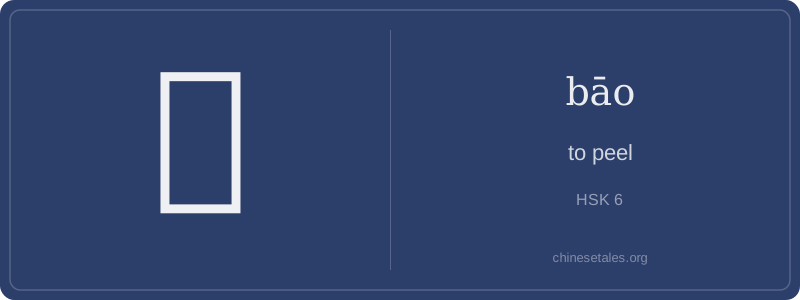
The earliest form of 剥 appears on Western Zhou bronze inscriptions as a composite pictograph: on the left, a stylized 'fruit' or 'object with layers' (originally resembling a melon or nut), and on the right, a hand holding a sharp tool — later simplified to the 刂 (knife) radical. Over centuries, the left side evolved from a detailed drawing of a segmented fruit into the modern 甫 (fǔ), which once represented a basket or container holding layered items; the right side hardened into the knife radical, emphasizing the *cutting action* required to separate layers. By the Han dynasty, the character stabilized into its current 10-stroke form — every stroke now serving a purpose: the top horizontal anchors the 'layered object', the verticals and hooks mimic the motion of prying and slicing, and the final 刂 is the decisive cut.
This visual logic directly shaped its semantic journey: from concrete peeling (of fruit, bark, or animal hides in ancient texts like the Book of Rites) to metaphorical stripping — like peeling away pretense in Tang poetry or political rhetoric in Ming-era essays. The Shuōwén Jiězì (121 CE) defines it as 'to remove the exterior, layer by layer', highlighting its iterative, laborious nature. Even today, the shape whispers its meaning: look at those tight, descending strokes beside the knife — they’re not random; they’re the curled shavings falling away.
At its core, 剥 (bāo) is a vivid, tactile verb meaning 'to peel' — but not just fruit or vegetables: it’s the act of *removing an outer layer by force*, whether it’s skin, paint, varnish, or even abstract things like illusions or privilege. Think of peeling an orange with your fingernails — that slight resistance, the curling strip coming away — that’s the visceral feel of 剥. It’s transitive and almost always requires a direct object (e.g., 剥橘子, 剥洋葱), and unlike many verbs, it rarely appears in isolation — you’ll almost never hear 'I’m peeling' without specifying *what*.
Grammatically, 剥 is famously flexible: it can appear in serial verb constructions (剥了皮再煮), as part of resultative complements (剥干净), and even in reduplicated form for emphasis or rhythm (剥剥剥!). A common learner trap? Using 剥 for 'strip' in passive or abstract contexts where Chinese prefers 剥夺 (bōduó, 'to deprive') — note the alternate pronunciation bō here! That bō reading only appears in formal, literary compounds like 剥削 (bōxuē, 'exploitation'), never in everyday peeling. Confusing bāo and bō mid-sentence is a classic HSK 6 slip-up — one tone shift changes your kitchen chore into a Marxist critique!
Culturally, 剥 carries subtle weight: in classical texts, it evokes ritual removal (e.g., peeling ceremonial bamboo slips), and today it subtly echoes ideas of revelation or exposure — think of news headlines like '剥开真相' ('peel open the truth'). Learners often overuse it for 'take off' (clothes → 脱, not 剥!) or misplace the tone — remember: bāo for peeling, bō only in stiff, compound-only contexts. Master it, and you’ll describe texture, process, and even social critique — all with ten strokes.