割
Character Story & Explanation
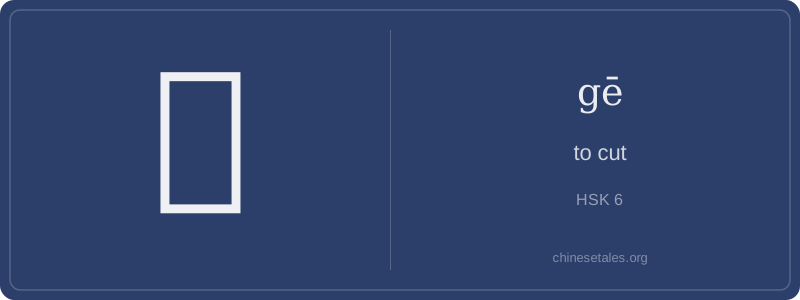
The earliest form of 割 appears in late Shang oracle bones as a composite: a hand (又, yòu) holding a sharp blade (刀, dāo) poised over a stalk-like shape — likely grain or hemp. In bronze inscriptions, the blade evolved into the radical 刂 (knife), while the top component solidified into 害 (hài), originally depicting a house with a roof and a worm — symbolizing ‘harm’ or ‘infliction’. By the Small Seal Script, 害 + 刂 fused visually, emphasizing that cutting isn’t neutral: it’s an act that inflicts change, removes, or damages — a semantic echo still felt today.
This duality — tool + consequence — persisted across millennia. In the Book of Rites, 割 appears in sacrificial contexts: ‘割牲以荐’ (cut the sacrificial animal to offer). Later, in the Mencius, it describes territorial loss: ‘割地而朝’ (cede land to pay homage). Even its modern usage preserves this gravitas: 割让 (ceding territory) evokes historical trauma, while 割爱 (cutting love) expresses profound emotional sacrifice. Visually, the 12 strokes mirror precision — seven in 害 (representing layers of complexity) and five in 刂 (the decisive strike).
At its core, 割 (gē) isn’t just ‘to cut’ — it’s the act of *intentional, decisive severance*: slicing through something substantial, often with consequence. Think harvesting rice, amputating a limb, or cutting ties in a business deal. Unlike generic verbs like 切 (qiē, 'to slice') or 剪 (jiǎn, 'to剪/cut with scissors'), 割 implies force, precision, and irrevocability — you don’t 割 paper; you 割 a contract. It carries subtle weight: in classical texts, 割 is used for ritual sacrifice (割牲) and territorial division (割地), embedding sovereignty and solemnity into the very stroke.
Grammatically, 割 is versatile but rarely stands alone. It’s almost always part of compound verbs (e.g., 割掉, 割断, 割让) or nouns (e.g., 割草机). Learners often mistakenly use it transitively without an object ('I cut' → *wǒ gē*), but native speakers require specification: 割草 (mow grass), 割腕 (wrist-cutting, a serious idiom), or 割爱 (‘cut love’ = reluctantly give up something cherished). The passive construction 割破 (gē pò, ‘be cut open’) also appears frequently — note how 割 + 破 emphasizes accidental, painful severance.
Culturally, 割 reflects Chinese pragmatism about boundaries: cutting away excess (割除肿瘤), ceding land (割地赔款), or even self-discipline (割舍欲望). A common learner trap? Confusing it with 刮 (guā, 'to scrape') — mispronouncing or miswriting leads to absurdities like ‘scraping the grass’ instead of ‘mowing it’. Also, avoid overusing 割 in casual speech; it sounds formal or grim unless context demands gravity.