劈
Character Story & Explanation
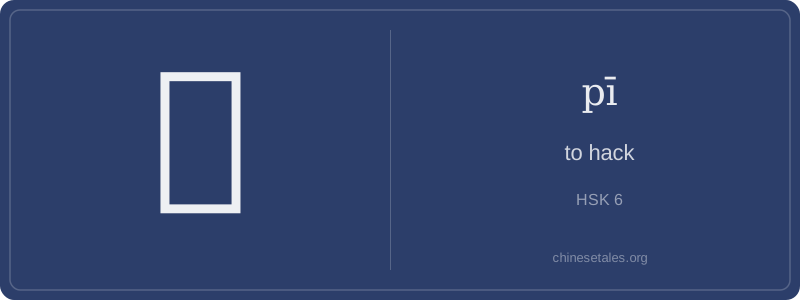
Carved on Shang dynasty oracle bones, the earliest ancestor of 劈 wasn’t yet this character — but its key components were already at work. The radical 刀 appeared as a simple, sharp-edged blade glyph. Meanwhile, 辟 emerged from a pictograph of a person (卩) standing beside a walled enclosure (辛), suggesting ‘removing someone from confinement’ — a conceptual root for ‘opening’ or ‘dispelling’. Over centuries, these elements fused: the blade radical anchored the meaning in physical force, while 辟 evolved graphically into the top half (辟 without the ‘person’ stroke), lending both sound and the nuance of forceful opening.
By the Han dynasty, 劈 solidified in seal script as a clear ‘blade + opening’ compound. Classical texts like the *Zuo Zhuan* used it for dramatic military actions — ‘the general 劈 the enemy’s formation’, emphasizing psychological rupture as much as physical damage. Its visual structure remains strikingly literal: the upper 辟 looks like a blade descending upon the lower 刀 — a rare case where the character’s layout mirrors its action: a downward slash culminating in the knife radical itself.
At its core, 劈 (pī) isn’t just ‘to hack’ — it’s the visceral, downward *shock* of a blade splitting something apart with force and precision: wood, rock, even metaphorical barriers. Think cleaver meeting log, not gentle slicing. The character’s radical 刀 (dāo, ‘knife’) anchors it firmly in the realm of cutting tools, while the phonetic component 辟 (bì/pì) hints at both sound and meaning — 辟 itself carries connotations of ‘opening up’, ‘dispelling’, or ‘making way’, reinforcing the idea of forceful separation.
Grammatically, 劈 is almost always a transitive verb requiring an object, and often appears in compound verbs like 劈开 (pī kāi, ‘to split open’) or as part of vivid descriptive phrases: 劈头盖脸 (pī tóu gài liǎn, ‘like a torrent hitting head-to-face’ — used for sudden, overwhelming criticism or rain). Learners mistakenly use it for general ‘cutting’ (use 切 or 割 instead); 劈 implies decisive, vertical, often dramatic force — you 劈 a log, not a cucumber.
Culturally, 劈 evokes martial arts imagery (劈掌 ‘splitting palm strike’) and classical drama — Sun Wukong famously 劈开华山 to rescue his mother! A common pitfall: confusing it with the homophone pǐ (as in 劈叉, pǐ chā, ‘splits’), where the tone shift signals a completely different action (spreading legs wide, not hacking). That tone change isn’t optional — it’s semantic.