剂
Character Story & Explanation
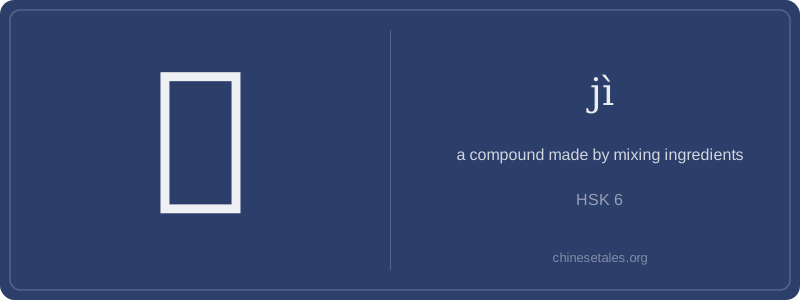
The earliest form of 剂 appears in Warring States bamboo slips as ⿰齐刂 — with ‘齐’ (qí, meaning ‘even, aligned’) on the left and the knife radical 刂 on the right. ‘齐’ wasn’t just phonetic; it evoked meticulous alignment of ingredients — like grains measured level in a scoop. Over time, the left side simplified from the full ‘齐’ (14 strokes) to its modern 6-stroke form 齐, while the knife radical remained steadfastly on the right, anchoring the character’s association with cutting, preparation, and precise division.
By the Han dynasty, 剂 had shifted from describing ritual grain offerings (where ingredients were ‘leveled’ and mixed) to medicinal compounds in texts like the *Shennong Bencao Jing*. Its knife radical signaled not violence, but *intervention*: the act of cutting raw herbs, grinding them, and blending them into a unified, active agent. This duality — ‘leveling’ + ‘cutting’ — gave 剂 its enduring sense of calibrated efficacy: not just ‘mixed stuff’, but ‘mixing with purpose and precision’.
Think of 剂 (jì) as Chinese chemistry’s ‘recipe unit’ — not the whole dish, but the precise blend that makes it work: a vaccine dose, a detergent formula, a hair-dye mix. Unlike English ‘agent’ or ‘substance’, 剂 always implies *intentional composition*: ingredients measured, combined, and activated for a specific effect. It’s never accidental — even ‘poison’ (毒剂) is a deliberately formulated compound.
Grammatically, 剂 is a noun suffix that turns abstract concepts into tangible, countable units — much like English ‘-er’ in ‘baker’ or ‘-ing’ in ‘building’, but for mixtures. You don’t say *‘a medicine’* — you say *yào jì* (药剂), literally ‘medicine compound’. It almost never stands alone; it clings to a preceding noun (e.g., 消毒剂, 催化剂). Learners often mistakenly use it like a generic ‘thing’ — but 剂 has zero meaning without its modifier. No ‘jì’ solo acts.
Culturally, 剂 carries quiet authority: it appears in life-or-death contexts (chemotherapy agents, nerve agents) and everyday ones (fabric softener, developer solution for film). A fascinating quirk? In classical texts, 剂 described herbal decoctions *adjusted to individual constitution* — a precursor to personalized medicine. Modern learners overlook this nuance and treat it as purely technical, missing its ancient roots in balance and precision.