劫
Character Story & Explanation
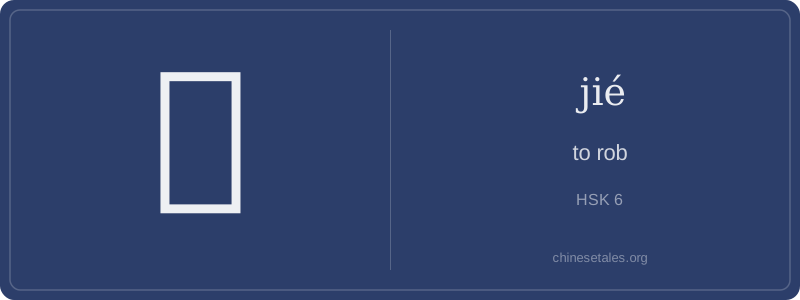
The earliest form of 劫 appears in bronze inscriptions as two components: a simplified depiction of a person (亻or 人) beside a hand wielding a weapon — later stylized into the left-side 㔾 (a variant of 去, implying ‘removal’) and the right-side 力 (lì, ‘strength’ or ‘force’). Over centuries, the left side condensed from 人+去 to 乛+一+口 (a clerical script simplification), while 力 retained its muscular, bent-arm shape — visually screaming ‘applied power’. By the Han dynasty, the seven-stroke modern form stabilized: the top hook (乛), horizontal (一), mouth-like box (口), and the decisive 力 anchoring the right — like a fist slamming down on stolen goods.
This visual violence directly shaped its meaning evolution. In the Shuōwén Jiězì (121 CE), 劫 is defined as ‘to seize by force, to take what isn’t yours’, already carrying legal and ethical weight. By the Tang dynasty, Buddhist texts adopted it for Sanskrit ‘kalpa’ (a cosmic eon), linking human-scale violence to universal cycles of creation and collapse — a 劫 wasn’t just robbery, but destiny’s brutal punctuation mark. The character’s compact fury — seven strokes packing moral, physical, and cosmic force — makes it one of Chinese writing’s most tightly wound semantic bombs.
At its core, 劫 (jié) isn’t just ‘to rob’ — it’s the visceral feeling of violent seizure: something ripped away *by force*, often suddenly and unjustly. It carries moral gravity; in Chinese thought, a 劫 implies violation of cosmic or social order — not petty theft, but an act that disrupts harmony (hé). That’s why it appears in Buddhist terms like 劫难 (jié nàn, 'calamity') and Daoist cosmology: a ‘kalpa’ (a vast cosmic cycle) is literally a ‘great劫’, marking epochs defined by destruction and renewal.
Grammatically, 劫 is almost always a verb, but unlike English ‘rob’, it rarely takes a direct object with ‘of’ — you don’t ‘rob someone of money’. Instead, it pairs with 人 (rén, ‘person’) or 地点 (dìdiǎn, ‘place’) as the target: 抢劫银行 (qiǎng jié yínháng, ‘rob a bank’) or 被劫持 (bèi jié chí, ‘be hijacked’). Crucially, it’s never used for gentle or metaphorical taking — no ‘robbing time’ or ‘robbing hearts’. Learners often overextend it like English ‘rob’, leading to unnatural sentences.
Culturally, 劫 resonates with deep-rooted ideas of fate and retribution. In classical novels like Water Margin, bandits who ‘rescue the poor and punish the corrupt’ may commit 劫, yet are celebrated — revealing how context can morally invert the act. Modern usage still echoes this duality: news reports say 劫机 (jié jī, ‘hijack a plane’) with clinical gravity, while literature uses 劫后余生 (jié hòu yú shēng, ‘surviving after calamity’) to evoke profound resilience. Mistake it for mere ‘theft’, and you miss the thunder behind the stroke.