卓
Character Story & Explanation
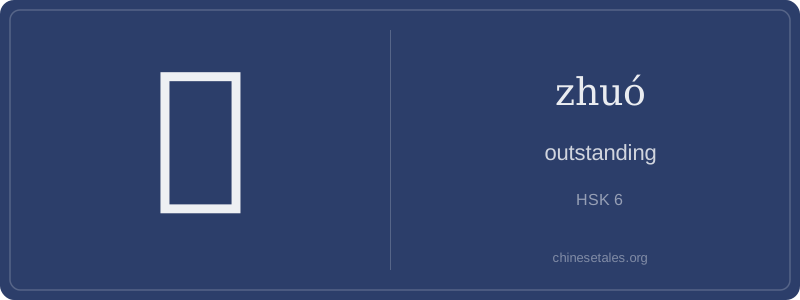
The earliest form of 卓 appears in bronze inscriptions as a stylized depiction of a tall, upright person standing on a platform — not just any platform, but one marked with a cross-shaped symbol (the precursor to 十). That cross wasn’t decorative: it represented a ritual altar or raised dais, signifying sacred elevation. Over centuries, the human figure simplified into two stacked horizontal strokes (亅 + 日-like shape), while the base solidified into 十 — not merely 'ten', but the visual anchor of height and centrality. By the seal script era, 卓 had crystallized into its modern structure: 十 at the bottom grounding the upper component, which evolved from a person to a stylized 'early' (早) minus 日 — preserving the idea of rising early, standing first, being foremost.
This visual logic directly shaped its semantic journey: from 'standing tall on a sacred platform' → 'eminent, conspicuous' → 'superior in ability or virtue'. In the *Analects*, Confucius praises Yan Hui’s moral stature using language echoing 卓’s essence: 'How admirable he is!' (*Hé qí měi yě!*). Later, in Tang dynasty poetry and Song dynasty scholarship, 卓 became the go-to character for describing penetrating insight — not just smart, but *so perceptive it seems to tower over ordinary understanding*. Its stroke count (8) even echoes its meaning: eight strokes feel balanced, deliberate, and upright — no flourish, no excess, just focused elevation.
卓 (zhuó) is that rare Chinese character that feels like a spotlight — it doesn’t just mean 'outstanding'; it conveys *unmistakable, elevated distinction*, often with an air of quiet authority or timeless excellence. Think less 'good at something' and more 'a towering figure in their field'. It’s rarely used alone: you’ll almost never say *‘tā hěn zhuó’* (he is outstanding) — that sounds stiff and unnatural. Instead, 卓 appears in compound adjectives (e.g., 卓越 *zhuóyuè*, 'exceptional') or as part of formal nouns (e.g., 卓识 *zhuóshí*, 'penetrating insight'). Its tone (4th) and crisp, open vowel give it a decisive, resonant quality — fitting for a word that implies standing above the crowd.
Grammatically, 卓 is almost always pre-nominal or pre-adjectival and carries strong written/formal register. You’ll find it in academic writing, official commendations, or classical-style prose — but rarely in casual speech or texting. Learners often mistakenly treat it like 著 (zhù, 'famous') or 优 (yōu, 'excellent'), leading to awkward phrasing like *‘zhuó de xuéshēng’* instead of the correct *‘zhuóyuè de xuéshēng’*. Also beware: 卓 is not a verb — you can’t ‘zhuó’ something; it modifies or elevates nouns/abstract qualities.
Culturally, 卓 evokes Confucian ideals of moral and intellectual eminence — not flashy talent, but deep, grounded excellence worthy of admiration and emulation. In imperial examinations and scholarly discourse, 卓 was reserved for those whose insight pierced superficiality. Today, it still carries weight: calling someone 卓尔不群 (*zhuó’ěr bù qún*, 'standing apart from the crowd') isn’t flattery — it’s near-veneration. A common trap? Overusing it in spoken contexts where simpler terms like 优秀 (*yōuxiù*) or 突出 (*tūchū*) would sound more natural and sincere.