叛
Character Story & Explanation
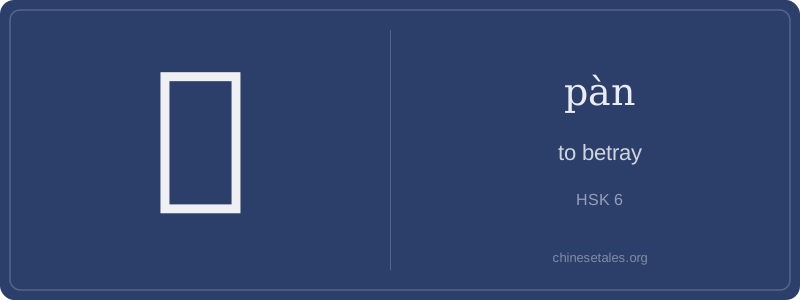
The earliest form of 叛 appears on Western Zhou bronze inscriptions around 1000 BCE — not as a pictograph, but as a compound ideograph. Its left side was originally 半 (bàn, 'half'), representing division or splitting, while the right side was 又 (yòu, 'again' or 'hand'), symbolizing action. Over centuries, 半 simplified into the top part we see today (a horizontal stroke + two short diagonal strokes), and 又 remained unchanged — giving us the modern 9-stroke structure: a clean split above, a decisive hand below. The character literally 'shows' a hand severing itself from the whole.
This visual logic shaped its meaning: from 'splitting away' in early texts like the Book of Documents (Shūjīng), where it described feudal lords abandoning their king, to full-blown 'treason' by the Warring States period. Mencius used 叛 to condemn rulers who lost the people’s mandate — not because they were defeated, but because they had *morally severed* themselves from virtue. The shape thus became a moral compass: if your hand moves against the whole, you’re 叛 — no appeal, no ambiguity.
Think of 叛 (pàn) as Chinese’s version of the word 'turncoat' — but with far more moral gravity. In English, 'betray' can be personal ('He betrayed my trust'), political ('She defected to the enemy'), or even abstract ('The data betrayed our hypothesis'). In Chinese, 叛 carries an almost Shakespearean weight: it implies a *voluntary, deliberate rupture* of loyalty — to a ruler, a teacher, a cause, or even Confucian ethics itself. It’s never casual; you don’t ‘叛’ your coffee order. You 叛 a dynasty, a party, or your sworn brotherhood.
Grammatically, 叛 is almost always transitive and formal — it takes a direct object marked by no particle (no 的, no 了 needed), and rarely appears in progressive or habitual forms. You’ll see it in headlines ('军方将领叛变') or classical-style prose, not chit-chat. Learners often wrongly use it like 背叛 (bèipàn), its more colloquial synonym — but 叛 alone is stark, literary, and punchy, like a gavel slamming down. You’d say 他叛国 (tā pàn guó), not *他叛了国 — the bare verb feels decisive and irreversible.
Culturally, 叛 isn’t just about disloyalty — it’s about *boundary violation*. In imperial China, betraying one’s lord wasn’t just illegal; it shattered the cosmic order (the Mandate of Heaven). Even today, calling someone a 叛徒 (pàntú, 'traitor') invokes deep social censure — far stronger than 'disloyal person'. A common mistake? Using 叛 where 拒绝 (jùjué, 'refuse') or 违反 (wéifǎn, 'violate') would be accurate and neutral. Don’t call a student who skips class a 叛师 — that’s overkill. Save 叛 for emperors deposed and oaths broken under moonlight.