丛
Character Story & Explanation
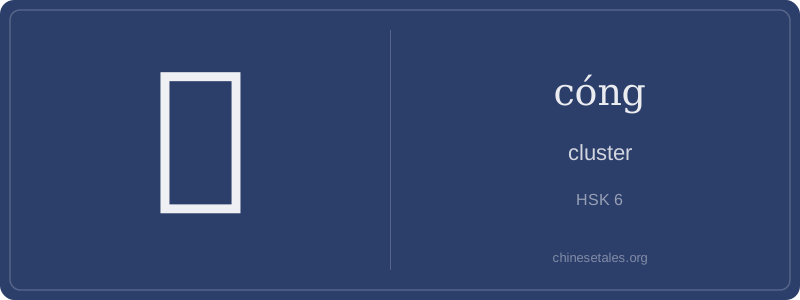
The earliest form of 丛 appears in late oracle bone inscriptions as two or three vertical strokes (like tiny plants) tightly grouped under a single horizontal line — not a roof, but a unifying ground or canopy. That top stroke wasn’t decorative; it represented the shared soil, horizon, or even a low-hanging branch binding the stems together. Over centuries, the number of verticals standardized to three (for visual balance), and the top stroke became cleaner and more rigid, evolving into today’s simple 一 radical — the very first stroke you write. The five-stroke structure (一 + 丨丨丨) is elegantly economical: no curves, no flourishes — just grounded verticality.
This pictorial logic persisted through bronze script and seal script: 丛 always meant ‘things growing densely from one base’. In the Book of Odes, it appears in phrases like ‘丛生之竹’ (cóngshēng zhī zhú, ‘bamboo growing in clusters’), emphasizing natural abundance without cultivation. By the Han dynasty, its meaning broadened metaphorically — ‘a cluster of ideas’, ‘a gathering of talents’ — but the visual anchor remained: unity through proximity, not hierarchy or origin. Interestingly, the character’s simplicity (just five strokes!) belies its semantic richness — it’s one of the oldest surviving ‘density markers’ in Chinese writing, predating even the concept of ‘forest’ as a distinct ecological category.
At its heart, 丛 (cóng) is about multiplicity in tight proximity — not just 'a group', but a dense, organic cluster where individual elements are hard to separate: think bamboo thickets, tangled vines, or a crowd pressing shoulder-to-shoulder. It’s inherently visual and spatial, evoking texture and density — unlike 把 (bǎ), which groups things for handling, or 群 (qún), which implies social cohesion among animate beings. You’ll rarely see 丛 stand alone; it almost always appears in compounds (e.g., 草丛, 丛林) or after measure words like 一丛 (yī cóng) — never as a verb or standalone noun.
Grammatically, 丛 functions exclusively as a measure word for plants growing in clumps (one丛 bamboo, three丛野花) or as a bound morpheme in nouns meaning 'thicket', 'grove', or 'cluster'. Crucially, it’s *not* used for people — saying 一丛人 would sound bizarrely dehumanizing, like calling a crowd a tangle of weeds! Learners often overextend it to animals or abstract concepts, but its domain is firmly botanical and topographic. Even in tech metaphors like 数据丛 (shùjù cóng, 'data cluster'), the image remains rooted in physical density and interconnection.
Culturally, 丛 carries subtle connotations of wildness and untamability — a 丛林 (cónglín) isn’t just 'forest' but implies dense, impenetrable wilderness (think Sun Wukong’s Mountain of Flowers and Fruit). Classical texts use it to evoke primordial chaos: the Classic of Mountains and Seas describes places where ‘trees grow in clusters, roots entwined like serpents’. A common mistake? Confusing it with 从 (cóng, 'from'), which shares pronunciation but has zero semantic overlap — mixing them up turns 'a thicket of orchids' into 'orchids from', causing delightful confusion.