叨
Character Story & Explanation
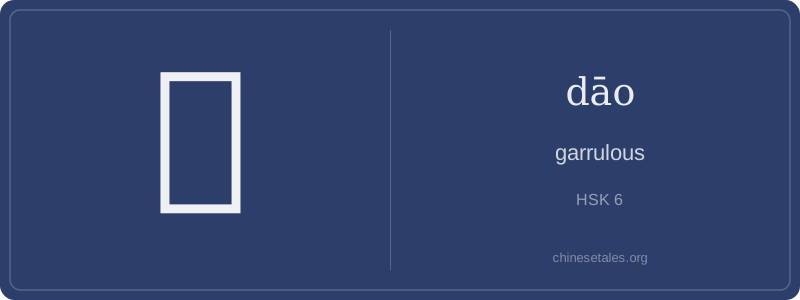
The earliest form of 叨 appears in late Warring States bamboo slips — not as a pictograph, but as a *phonosemantic compound*. Its left side 口 (kǒu, ‘mouth’) clearly signals speech-related meaning, while its right side 刀 (dāo, ‘knife’) originally served *purely as a phonetic hint*, approximating the ancient pronunciation /*taw/. Over time, the knife component simplified from 刂 to the modern 刀-like stroke — but crucially, no ‘cutting’ meaning was ever intended. Visually, it’s five clean strokes: vertical mouth frame (丨+冂), then three quick dashes inside (一、一、丿) — mimicking rapid, staccato speech sounds.
This character didn’t exist in oracle bone inscriptions; it emerged during the Eastern Zhou as vernacular speech flourished. In classical texts, it’s rare — but by the Ming-Qing vernacular novels (like *Dream of the Red Chamber*), 叨叨 appears in dialogue to capture servants’ or maids’ rapid, anxious chatter. The visual simplicity (just 5 strokes!) contrasts sharply with its rich pragmatic weight: a tiny mouth + a ‘knife’ sound = speech so frequent it feels like gentle pricks — not wounds, but persistent little taps on the ear.
Think of 叨 (dāo) as the linguistic equivalent of a talkative parrot perched on your shoulder — it’s all about *repetitive, slightly intrusive, chatter*. Unlike general ‘talking’ words like 说 (shuō) or 讲 (jiǎng), 叨 carries a subtle, affectionate-yet-exasperated nuance: not just speaking, but *nattering*, *rambling*, or *going on and on* — often about trivial things, sometimes endearingly, sometimes annoyingly. It’s rarely used alone; you’ll almost always see it reduplicated as 叨叨 (dāo dāo) or in compounds like 叨唠 (dāo láo).
Grammatically, 叨 is almost exclusively verbal and colloquial — never formal or literary. You’ll hear it in spoken Mandarin when someone’s gently teasing a parent who repeats advice ('Mom, stop 叨叨 me about my sleep schedule!'), or describing an elderly relative who ‘talks endlessly while folding dumpling wrappers’. Crucially, it’s *not* used for serious discourse, debate, or narration — that’s why HSK 6 learners encounter it only after mastering core verbs: it’s a fine-grained register marker, signaling warmth, familiarity, and mild exasperation all at once.
Culturally, 叨 reflects a beautiful Chinese linguistic habit: using sound symbolism and reduplication to encode attitude. Learners often mistakenly use 叨 in formal writing or with strong negative judgment (e.g., 'he’s *rude* for 叨'); but 叨 is rarely truly rude — it’s embedded in intimacy. A common error is confusing it with 韬 (tāo, 'to conceal') or 刀 (dāo, 'knife') due to similar pronunciation or shape — but 叨 lives in the mouth (口 radical!) and the ear, not the armory or the strategy manual.