叭
Character Story & Explanation
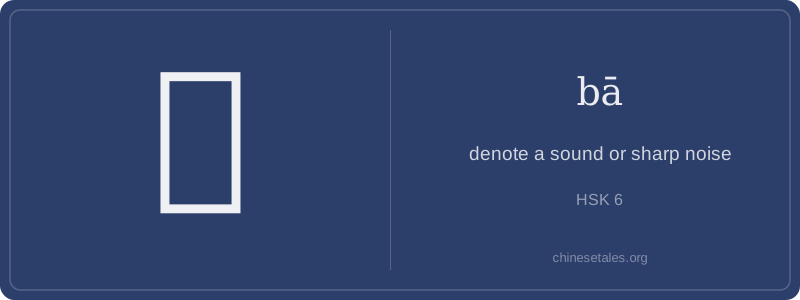
The earliest form of 叭 appears not in oracle bones, but in Tang dynasty calligraphic variants — a deliberate simplification of the character 吶 (nà), which itself evolved from 口 (mouth) + 纳 (nà, to receive). Scribes shaved off 吶’s complex right side, keeping just 口 and the essential ‘ba’-sound cue: the top stroke (丿) and the bottom ‘heng zhe na’ (㇏) mimicking the explosive release of air. Visually, it’s five strokes — mouth open, tongue poised — like a single frame from a slow-motion ‘pop’. By the Song dynasty, 叭 was standardized: 口 (radical) + the phonetic fragment 巴 (bā), though 巴 here isn’t the full character — it’s a streamlined glyph capturing both sound and shape.
This visual economy reflects its semantic evolution: from classical ‘shouting to attract attention’ (in military signals) to Ming-Qing vernacular fiction, where 叭 became the go-to for comic or urgent sounds — think water-splashing in Jin Ping Mei or a startled horse’s snort in Water Margin. Its compactness made it perfect for woodblock print margins and opera scripts, where space was scarce and impact immediate. Even today, its five-stroke minimalism mirrors its function: no frills, no delay — just pure acoustic punctuation.
Imagine you’re watching a slapstick comedy in Shanghai — suddenly, bā! — a cartoonish firecracker explodes, startling a duck into flight. That bā isn’t just sound; it’s a linguistic exclamation mark: sharp, sudden, and vividly onomatopoeic. In Chinese, 叭 doesn’t mean ‘a sound’ abstractly — it’s the *exact* auditory snap of something abrupt: a pistol crack, a door slamming, or even a stern, clipped command (like a drill sergeant barking ‘bā!’ to halt movement). It’s not a noun or verb by itself — it’s almost always used as an interjection or reduplicated (bā bā) for rhythmic emphasis, often paired with verbs like shuō (say) or jiào (shout).
Grammatically, 叭 is rarely standalone in formal writing but thrives in dialogue, comics, and descriptive prose. Learners often misplace it — trying to use it like English ‘bang!’ as a full sentence (‘Bā!’), when native speakers more naturally embed it: ‘Tā bā de yí shēng jiào le qǐlái’ (He shouted with a sharp bā!, jumping up). It’s also easily overused — unlike English onomatopoeia, Chinese prefers restraint: one 叭 carries more weight than three.
Culturally, 叭 appears in Buddhist mantras (e.g., ān mā ní bā mī hōng), where its ‘bā’ syllable represents awakening energy — but that’s Sanskrit transliteration, not native meaning. The real quirk? It’s HSK 6 not because it’s hard, but because it’s *too easy to misuse*: learners hear it in cartoons and assume it’s casual slang, when actually its precision makes it a stylistic luxury — deployed only when sonic authenticity matters most.