叮
Character Story & Explanation
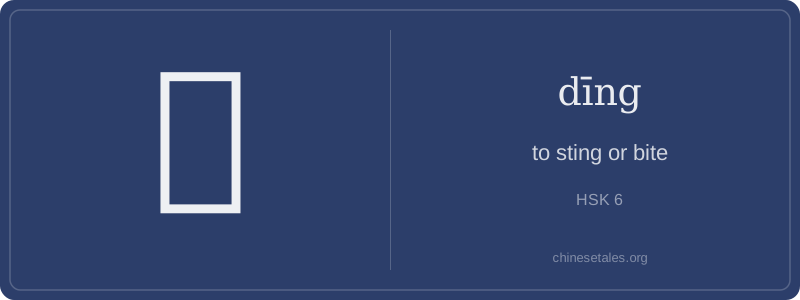
The earliest form of 叮 appears in seal script as 口 + 丁 — no pictograph of insects or stingers. The 口 (kǒu, ‘mouth’) radical signals this is about *sound*, not physical action. The 丁 (dīng) component, originally a pictograph of a nail-head or a sturdy peg in oracle bone script, was borrowed here purely for its pronunciation — making 叮 a classic phono-semantic compound. Visually, it’s minimalist: five clean strokes — a square mouth (口) plus a simple crossbar-and-vertical (丁). Its elegance lies in its economy: one radical declares ‘this is vocal/aural’, the other whispers ‘dīng’ — and together they conjure both the *sound* of a sting and the *sensation* of it.
This sound-to-action semantic shift mirrors how Chinese often maps sensory experience: the sharp ‘ding!’ of a bee’s approach becomes synonymous with its puncture. Classical texts rarely use 叮 alone for stinging; it emerges more robustly in Ming-Qing vernacular fiction, where authors needed vivid, onomatopoeic verbs for everyday irritations — like mosquitoes buzzing around a scholar’s lamp. In 《金瓶梅》, 叮 appears in descriptions of ‘insects humming and stinging’ — always paired with movement and sound, never isolation. The character’s visual simplicity (just 口 + 丁) reinforces its function: it doesn’t depict violence — it *recreates the moment just before*.
At first glance, 叮 (dīng) feels like a tiny, sharp little sound — and that’s exactly the point. It’s an onomatopoeic character rooted in *sound*, not sting: its core meaning is the high-pitched 'ding!' or 'tink!' of a small metal object striking another — think of a tiny bell, a needle tapping glass, or a bee’s wing vibrating just before it lands. Over time, this auditory sharpness bled into action: because stings and bites are sudden, piercing, and often accompanied by a quick, high-pitched sensation (or even the insect’s buzz), 叮 came to mean ‘to sting’ or ‘to bite’ — but only for *small, sharp, rapid* agents: mosquitoes, bees, wasps, or even metaphorical ‘stings’ like sharp criticism. You’ll never say 蛇叮人 (snake stings a person); snakes *bite* (咬), not 叮.
Grammatically, 叮 is almost always transitive and appears in vivid, colloquial, or literary descriptions — rarely in formal writing. It pairs naturally with reduplication (叮叮) for rhythmic emphasis or repetition (e.g., 蚊子叮叮咬咬), and often appears in compound verbs like 叮咬 (dīng yǎo) — where 叮 adds the nuance of *piercing precision*, while 咬 contributes brute force. Learners mistakenly use it as a general synonym for ‘bite’, but native speakers instantly sense the mismatch: 叮 implies speed, smallness, and acoustic resonance — not pain or damage.
Culturally, 叮 carries a light, almost playful edge — even when describing annoyance. A mosquito 叮 you isn’t threatening; it’s pesky, insistent, and faintly musical. That’s why it appears in idioms like 叮咚作响 (dīng dōng zuò xiǎng, ‘jingling loudly’) and poetic lines evoking dewdrops or wind chimes. The biggest trap? Confusing it with 钉 (dīng, ‘nail’) — same pinyin, same radical, but entirely different origin and usage. Remember: 口 means *sound*, not *metal*.