叼
Character Story & Explanation
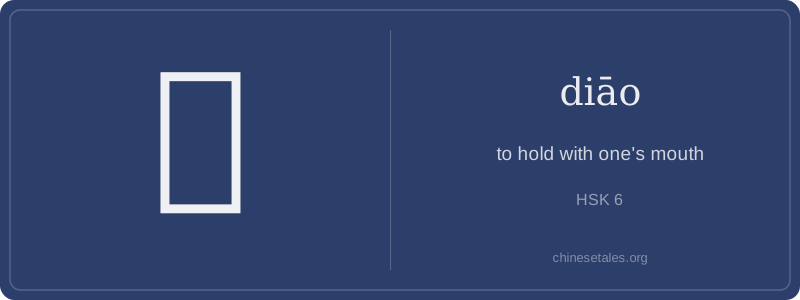
The earliest form of 叼 appears in Han dynasty clerical script as a stylized fusion: the left side 口 (kǒu, 'mouth') anchoring the action, and the right side — originally a simplified depiction of a curved beak or jaw — evolving into today’s 丿一㇏ stroke cluster. Oracle bone inscriptions don’t contain 叼, but bronze script precursors show birds with elongated beaks gripping twigs, and scribes gradually abstracted that grasping motion into three strokes: a downward slash (丿), a horizontal line (一), and a sweeping捺 (㇏) mimicking the arc of a closed jaw holding something firmly yet lightly.
This visual logic endured: every stroke reinforces oral agency — the mouth initiates, the shape implies precision and control. By the Tang dynasty, 叼 was already idiomatic in poetry describing sparrows carrying straw (《燕诗》: '衔泥两椽间,一巢生四儿' — though 衔 is more classical, 叼 gained colloquial traction). Its modern dominance emerged in 20th-century fiction and film scripts, where directors needed a verb to show characters moving while holding things orally — making 叼 the go-to for cinematic economy and expressive flair.
At its heart, 叼 (diāo) is all about mouth-powered grip — not chewing, not swallowing, but that quick, temporary hold: a dog grabbing a bone, a mother bird ferrying a worm, even a person snatching a cigarette between their lips. It’s an action verb with strong visual immediacy and slight informality — rarely used in formal documents or ceremonial speech, but vividly alive in storytelling, journalism, and colloquial narration. Unlike 含 (hán, 'to hold in mouth passively') or 咬 (yǎo, 'to bite down'), 叼 implies control without pressure: the object stays intact, uncrushed, suspended by oral dexterity.
Grammatically, 叼 is almost always transitive and often appears in dynamic narrative sequences — especially with verbs of motion ('ran over', 'flew away', 'stomped off') to heighten urgency or comic timing. You’ll rarely see it alone; it thrives in phrases like 叼着烟卷就冲出去了 ('with a cigarette dangling from his lips, he dashed out'). Learners sometimes mistakenly use it for eating (e.g., *他叼了一口饭), but 叼 doesn’t convey ingestion — that’s 啃 (kěn) or 咬. Also, it’s almost never used reflexively or with abstract nouns — you can’t ‘*叼一个想法’.
Culturally, 叼 carries a subtle edge of casual defiance or nonchalance: 叼着牙签 (diāo zhe yáqiān, 'to hold a toothpick in one’s mouth') signals swagger; 叼着笔 (diāo zhe bǐ, 'pen held in mouth') paints a distracted scholar. A common error? Confusing it with 叨 (dāo, 'to chatter') — same radical, different tone and meaning, and *very* different energy. One is silent grip; the other is noisy talk.