呈
Character Story & Explanation
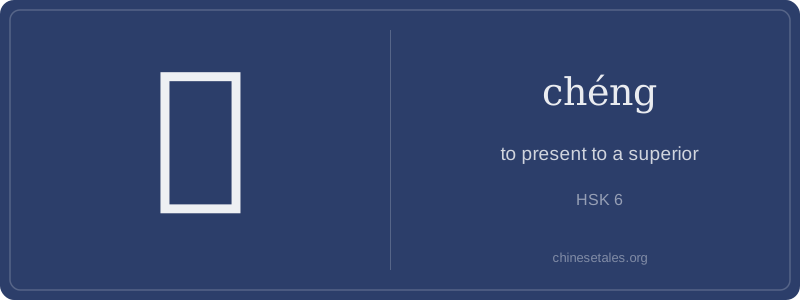
The earliest form of 呈 appears in bronze inscriptions as a stylized figure standing upright (壬) above a mouth (口), evoking someone speaking or declaring while maintaining proper bearing before a ruler. Over time, the upper element evolved: in seal script, it became a clear 壬 — a vertical line flanked by two short horizontal strokes, symbolizing a person standing tall and centered. The 口 remained firmly anchored below, grounding the act in vocal or symbolic articulation. By the Han dynasty clerical script, the shape stabilized into today’s seven-stroke form: the top horizontal stroke, then the ‘person’ structure (丨一丨), capped by the 口 — visually, a dignified figure offering words from the mouth to those above.
This visual logic shaped its meaning: in classical texts like the *Book of Rites* (Lǐjì), 呈 described the ritual act of ministers presenting memorials (奏章 zòuzhāng) to the emperor — always kneeling, hands raised, voice controlled. Its use in Tang and Song dynasties expanded to include offerings of poetry or tribute goods, always emphasizing the vertical axis of respect. Interestingly, the same glyph later birthed 呈现 (chéngxiàn), where ‘presentation’ became ‘manifestation’ — as if reality itself were being respectfully unveiled before perception, echoing its ancient role as a conduit between human action and higher order.
At its core, 呈 (chéng) carries the quiet gravity of hierarchy — it’s not just ‘to present,’ but to present *upward*: to a superior, an authority, or an institution. Think less ‘handing something to a friend’ and more ‘bowing slightly while placing a report on your boss’s desk.’ This subtle power dynamic is baked into the character: the 口 (mouth) radical hints at speech or declaration, while the top component (壬 rén, an ancient pictograph for ‘standing person’) suggests posture, formality, and respectful positioning. It’s never casual — you’d never 呈 your lunch to a classmate.
Grammatically, 呈 is almost always transitive and formal. It commonly appears in written registers: government documents, academic submissions, or ceremonial contexts. You’ll see it as a verb (呈交 chéngjiāo — ‘submit formally’) or in passive constructions (呈报给上级 chéngbào gěi shàngjí — ‘report to superiors’). Crucially, it rarely stands alone — it’s almost always paired with verbs like 交 (submit), 报 (report), or 上 (offer upward). Learners often mistakenly use it like 送 (sòng, ‘to send’) or 给 (gěi, ‘to give’), but 呈 implies deference, not neutrality.
Culturally, 呈 reflects Confucian social architecture — the act of presenting isn’t about the object, but about acknowledging rank and maintaining ritual propriety. A common error is overusing it in spoken Chinese; native speakers reserve it for official or literary contexts. In modern usage, it’s also found in set phrases like 呈现 (chéngxiàn, ‘to display/manifest’), where the ‘upward presentation’ sense has softened into ‘bringing forth visibly’ — a fascinating semantic drift from court protocol to abstract appearance.