呵
Character Story & Explanation
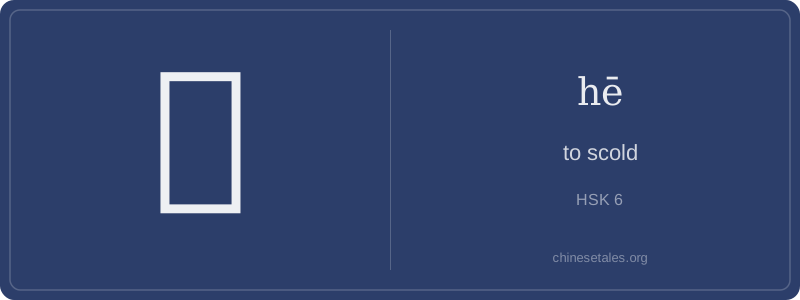
Oracle bone inscriptions show no direct precursor to 呵, but its earliest bronze script forms (c. 1000 BCE) already combine 口 (mouth) with 何 — originally a pictograph of a person holding a weapon (a halberd-like shape) beside a ‘person’ (亻) and ‘field’ (田) — later simplified into the phonetic 何. Over centuries, the weapon element vanished, and 何 stabilized as a sound marker. The eight-stroke modern form emerged by the Han dynasty: three strokes for 口 (left), then five for 何 (right) — the dot, horizontal, vertical, hook, and final stroke — preserving the mouth-as-source-of-voice logic.
This visual logic shaped its semantic journey: from ‘voice + what?’ (何) → ‘what is this?!’ → rhetorical indignation → moral censure. By the Tang dynasty, poets like Du Fu used 呵 in lines like ‘呵壁问天’ (‘scold the wall and question heaven’), expressing righteous fury at injustice — cementing its association with principled, almost performative rebuke. Its mouth radical isn’t about volume, but about voice as moral instrument: the mouth that speaks truth, not just noise.
At first glance, 呵 (hē) feels like a quiet character — just a mouth radical 口 plus the phonetic component 何 (hé). But don’t be fooled: this is the sound of a sharp, disapproving exhale — not gentle laughter (that’s 呵 hē in other contexts!) but the verbal equivalent of a raised eyebrow and a clipped, breathy scold. In modern usage, it’s almost exclusively literary or rhetorical: you’ll hear it in classical-style essays, political commentary, or dramatic dialogue where someone ‘harshly rebukes’ an absurd idea — never in casual texting or daily scolding (for that, Chinese uses 啊, 哎, or verbs like 责备 or 批评).
Grammatically, 呵 functions as a monosyllabic verb meaning ‘to reprimand sharply’, usually followed by a direct object (e.g., 呵斥某人) or used in compound verbs like 呵责 or 呵斥. It rarely stands alone in speech — unlike English ‘scold’, it doesn’t take an -ing form or appear in progressive tenses; instead, it’s tightly bound to formal register and moral authority. Learners often misread it as the interjection ‘he!’ (like a laugh or sigh), missing its biting edge — a subtle but critical tonal and contextual shift.
Culturally, 呵 embodies the Confucian weight of ‘righteous admonition’: not petty nagging, but stern correction rooted in principle. That’s why it appears in phrases like 呵问 (‘to challenge sharply’) — think of a scholar confronting corruption, not a parent yelling at homework. A common mistake? Using it conversationally — native speakers would find it jarringly theatrical. Save 呵 for writing that demands moral gravity, and let everyday scolding live in simpler, warmer words.