呻
Character Story & Explanation
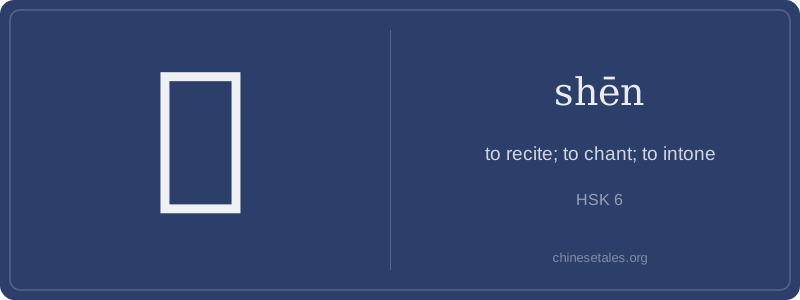
The earliest form of 呻 appears in seal script as 口 + 申 — no oracle bone trace survives, but bronze inscriptions show 申 as a stylized lightning bolt or extended arm, symbolizing 'to stretch forth' or 'to declare'. In small seal script, 口 sits firmly left, while 申 evolves from three connected vertical strokes (representing extension) into its modern bent, looping shape — the top stroke curves down, the middle bends right, and the bottom sweeps left, mimicking the elongated resonance of voiced utterance. Every stroke in today’s 呻 echoes that idea of controlled, outward projection: the mouth initiates, the body (申) channels and extends.
This visual logic shaped its semantic path. In the *Zuo Zhuan* and early Han texts, 呻 appears in phrases like 呻诗 (shēn shī), meaning to chant poetry with tonal fidelity — not just speaking, but embodying rhythm and intent. By the Tang dynasty, Buddhist translators used it for Sanskrit mantra recitation (e.g., 呻咒), emphasizing sonic precision over meaning. Even today, its form whispers: this is not idle talk — it’s voice made disciplined, sound made sacred, breath made text.
At first glance, 呻 (shēn) feels like a quiet, rhythmic character — and it is. Its core meaning isn’t groaning or pain (a common false friend!), but rather the deliberate, resonant vocalization of words: reciting, chanting, or intoning — especially with ritual gravity or poetic cadence. Think of a Daoist priest drawing out sacred syllables, or a scholar reading classical verse aloud with measured breath and tonal precision. The mouth radical 口 signals vocal action, while the right side 申 (shēn) both hints at the pronunciation and subtly evokes ‘extension’ — as in stretching sound through time and space.
Grammatically, 呻 is almost always transitive and formal, requiring an object: you 呻一首诗 (recite a poem), 呻经 (chant sutras), never just ‘I shēn’. It’s rarely used in casual speech — you’d say 背 (bèi) for memorized recitation or 读 (dú) for ordinary reading. Learners often mistakenly use it for ‘moan’ (that’s 呻吟, shēnyín — a two-character compound where 呻 alone doesn’t carry that meaning). Also, note: it’s not used for singing (唱, chàng) or shouting (喊, hǎn).
Culturally, 呻 carries an aura of solemnity and tradition. In classical contexts, it implies reverence — the voice becomes a vessel, not just a tool. Modern usage is sparse but potent: literary essays, historical dramas, or satirical critiques (e.g., 呻着官腔 — 'intoning official-speak' — mocking bureaucratic rhetoric). A frequent error? Overgeneralizing from 呻吟; remember: 呻 alone is elegant, intentional, and deeply textual — not visceral or emotional.