咀
Character Story & Explanation
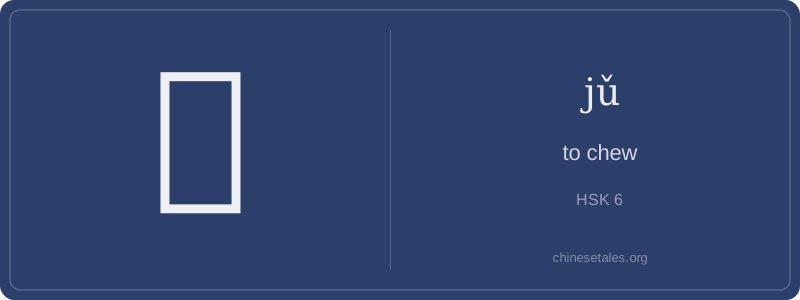
Oracle bone inscriptions show no direct precursor to 咀, but its earliest form appears on Warring States bamboo slips as a combination of 口 (mouth) and a simplified 且 — which itself originated as a pictograph of a ritual altar with stacked offerings. The eight strokes of modern 咀 crystallized during the Han dynasty: the left 口 is clean and compact, while the right 且 evolved from three horizontal lines (symbolizing layered sacrifice) into today’s two short horizontals plus a longer base stroke — visually mimicking teeth grinding down substance. Interestingly, the top stroke of 且 was originally a dot or short dash representing incense smoke rising — linking chewing to ritual digestion of the sacred.
By the Tang dynasty, 咀 had shifted from purely physical chewing to metaphorical 'digestion' of language and wisdom. Li Bai used 咀 in a line about 'chewing moonlight like jade' (咀月如嚼玉), turning mastication into aesthetic contemplation. The character’s visual duality — mouth + ritual stack — became semantic: it’s not just biting, but *reverent breakdown*. Even today, when scholars say 咀嚼经典 (jǔ jué jīngdiǎn), they’re not just reading classics — they’re ritually dismantling them, grain by grain, to extract essence.
At its core, 咀 (jǔ) is the elegant, precise verb for 'to chew' — not just the physical act, but the thoughtful, deliberate processing of food or even ideas. Unlike the more colloquial 啃 (kěn, 'to gnaw') or generic 吃 (chī, 'to eat'), 咀 carries a quiet intensity: it’s what you do when savoring aged tea, dissecting a dense philosophical passage, or slowly breaking down tough gristle. Its mouth radical 口 immediately signals oral action, while the right side — 且 (qiě) — isn’t just phonetic; in ancient usage, 且 evoked ritual offering and careful presentation, subtly reinforcing the idea of intentional, almost ceremonial mastication.
Grammatically, 咀 is nearly always used in compounds, rarely standalone. You’ll almost never hear '他咀' — instead, it appears in verbs like 咀嚼 (jǔ jué, 'to chew thoroughly') or literary phrases like 咀味 (jǔ wèi, 'to savor the flavor/taste of something abstract'). It also appears in classical-style set expressions such as 咀英 (jǔ yīng, 'to chew on excellence') — a poetic way to say 'to deeply absorb refined knowledge'. Learners often mispronounce it as 'zuǐ' (like 嘴), but that’s only valid in one rare, archaic compound (咀咁, zuǐ gàn — an obsolete variant meaning 'to speak bluntly'); for all modern usage, jǔ is the only correct reading.
Culturally, 咀 reflects China’s deep-rooted connection between bodily action and intellectual refinement — chewing isn’t crude biology; it’s the first step in internalizing value. A common mistake is overusing it in spoken Mandarin; it sounds overly literary or even pretentious in casual chat. Save it for essays, poetry, or describing slow, mindful acts — like chewing *xuan paper* in calligraphy practice (a real, if niche, metaphor for absorbing tradition).