咋
Character Story & Explanation
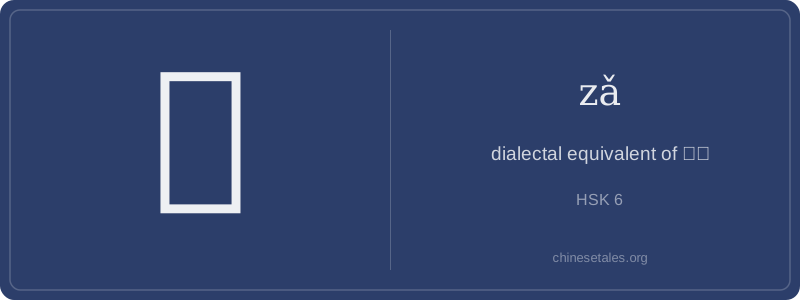
咋 has no oracle bone or bronze script ancestry — it’s a latecomer, born in the Ming–Qing vernacular explosion. Its form is brilliantly pragmatic: take the phonetic component 乍 (zhà, ‘suddenly’), which itself evolved from a pictograph of a person startled upright (亅 + 作-like element), then add the 口 (mouth) radical on the left — signaling this is a *spoken* variant. The eight strokes flow: first the three-stroke 口, then 乍’s sharp, angular strokes (丿一丨一丨丿丶), mimicking the abruptness of a spoken question.
咋 first appeared in Ming dynasty storytelling manuscripts and Qing folk operas as a colloquial stand-in for 怎麼 — likely because 乍 sounded close enough to the local pronunciation of ‘zěn’, and adding 口 made its oral function unmistakable. Unlike classical characters tied to ritual or philosophy, 咋 was forged in teahouses and alleyways. No Confucian text uses it; it’s absent from the Kangxi Dictionary — yet today, it thrums through millions of daily conversations, proving that language isn’t just preserved in books, but kept alive in the mouth.
咋 (zǎ) isn’t just ‘how’ — it’s the linguistic equivalent of rolling up your sleeves and leaning in. In Northern and Southwest Mandarin dialects (especially Henan, Shaanxi, Sichuan), 咋 carries warmth, immediacy, and unfiltered familiarity — think of a grandmother squinting at you over steaming dumplings: ‘咋不吃饭?’ It’s never formal, never written in official documents, but pulses with life in spoken exchanges, often replacing 怎麼 (zěnme) without changing meaning — just flavor. Unlike standard Mandarin’s neutral tone, 咋 sounds earthy, slightly clipped, like a quick exhale.
Grammatically, it functions identically to 怎麼: as an interrogative adverb before verbs (咋来啦?), adjectives (咋这么晚?), or even standalone (咋了?). Crucially, it *never* takes aspect particles like 了 or 过 directly after it — you say 咋来的? not 咋了? (that would mean ‘what happened?’ — a different word entirely!). Learners often misread 咋 as ‘za’ (like ‘pizza’) or overuse it in formal writing — a dead giveaway of non-native speech.
Culturally, 咋 reveals how Chinese values linguistic efficiency *and* relational intimacy: shortening 怎麼 → 咋 saves two strokes and a syllable, while the 口 radical signals it’s meant for the mouth — not the page. It’s oral culture in ink: living, breathing, regional, and defiantly informal. To use it well is to signal you’re not just speaking Chinese — you’re *talking* with it.