咽
Character Story & Explanation
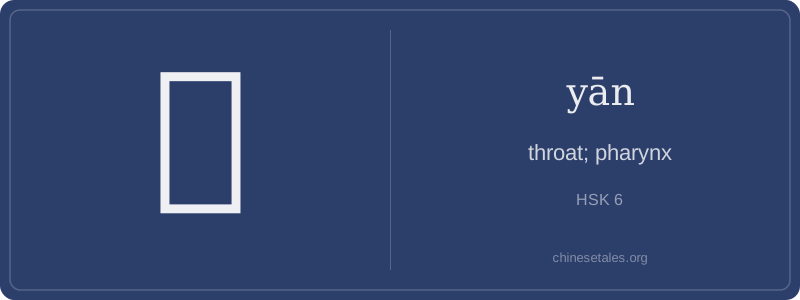
The earliest form of 咽 appears in bronze inscriptions as a combination of 口 (mouth opening) and 丷 + 冖 + 水-like strokes — suggesting flowing liquid or air passing through a constricted passage. Over time, the upper part simplified into the distinctive 'open mouth with descending stroke' shape: the 口 radical anchors it as an oral cavity concept, while the right side evolved from a pictograph of converging channels (like two streams narrowing into one duct) into today’s 9-stroke form — the diagonal stroke (piě) mimics the downward path of swallowed food, and the final dot (diǎn) hints at the tiny, vital junction where respiration and ingestion cross paths.
This visual logic carried into meaning: by the Warring States period, 咽 appeared in texts like the *Lüshi Chunqiu* to denote both the physical passage and the act of swallowing. In classical poetry, it gained emotional weight — Du Fu wrote of 'swallowing sorrow' (咽悲声), using yàn to imply suppression, not ingestion. The character’s dual nature — anatomical precision and expressive vulnerability — made it indispensable for describing moments when language fails: the catch before tears, the pause before truth. Even today, its shape whispers: this is where voice begins and ends.
At its core, 咽 (yān) isn’t just a clinical term for 'pharynx' — it’s the body’s silent threshold where breath becomes voice, food becomes fuel, and emotion gets physically stuck. In Chinese thinking, the throat is deeply tied to emotional restraint: think of the lump-in-throat sensation when you’re too moved to speak — that’s 咽 in action. Unlike English, which separates 'swallow', 'gasp', and 'throat' into distinct words, Chinese uses the same character root across three pronunciations to map physiology to feeling: yān (anatomy), yàn (to swallow), and yè (to choke back sobs). This triad reveals a holistic worldview — no sharp divide between body, action, and affect.
Grammatically, yān appears almost exclusively in compound nouns (e.g., 咽喉 'throat') or formal/medical contexts; you’ll rarely use it alone. Learners often mistakenly try to say 'I have a sore throat' as *wǒ de yān hěn tòng* — but native speakers say 喉咙痛 (hóu lóng tòng) or, more naturally, 我嗓子疼 (wǒ sǎng zi téng). Why? Because 咽 is too technical and anatomically precise for everyday speech — like saying 'I have pharyngeal discomfort' instead of 'my throat hurts'.
Culturally, 咽 shows up powerfully in idioms and literature: 咽气 (yàn qì, 'to swallow one’s last breath') evokes quiet, dignified passing — not gasping, but a deliberate, internalized release. A common learner trap is overusing yān where colloquial terms dominate; another is mispronouncing yè (as in 哽咽 'to choke up') as yān — which turns heartfelt weeping into a dry anatomy lesson. Remember: yān = structure, yàn = action, yè = emotion — and all three live in one elegant, nine-stroke doorway.