哼
Character Story & Explanation
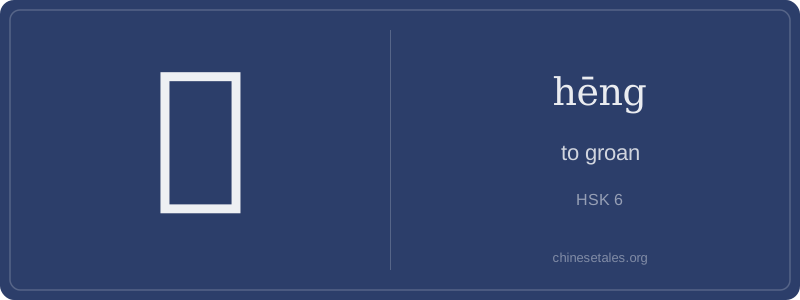
The earliest form of 哼 appears in bronze inscriptions (c. 1000 BCE) as a combination of 口 and 亯 (a variant of 亨), where 亯 depicted a vessel steaming upward — symbolizing unobstructed flow. Over centuries, the top of 亯 simplified into the clean horizontal stroke and dot we see today, while the lower part became the angular 'x' shape (representing crossed paths or dispersal), and the 口 remained steadfastly at the left — a visual anchor for the mouth's role in producing sound. By the seal script era, the structure stabilized into the modern 10-stroke form: 口 + 亨, with 亨 itself evolving from a pictograph of ascending vapor into a stylized phonetic component.
This evolution mirrors a fascinating semantic shift: from 'prosperous flow' (亨) to 'nasal resonance' (哼). The connection lies in breath — both concepts rely on unimpeded air movement. In the Shuō Wén Jiě Zì (121 CE), Xu Shen defines 哼 as 'to exhale through the nose while closing the mouth', linking it directly to qigong-like breathing control. Later, in Ming dynasty vernacular fiction like Water Margin, 哼 appears frequently in dialogue tags ('Wú sōng hēng le yì shēng') to signal a warrior’s simmering anger — cementing its role as the written echo of suppressed intensity.
At its core, 哼 is a vocalization character — not a full verb like 'groan' in English, but a sound-icon: a written representation of an involuntary, nasal, closed-mouth exhalation. It’s anchored by the 口 (mouth) radical, telling you instantly this is about speech or sound — and indeed, every character with 口 relates to oral activity (shouting, swallowing, singing, coughing). The right side, 亨 (hēng), is both phonetic and semantic: it originally meant 'to prosper' or 'unimpeded passage' (think of steam rising freely), but here it’s repurposed purely for its nasal 'hēng' sound — a perfect match for the resonant hum or grunt.
Grammatically, 哼 is almost always used as an interjection or onomatopoeic verb — never as a transitive verb (*I hum him* is impossible). You’ll see it in two main patterns: standalone (e.g., Hēng! — 'Hmph!') expressing disdain, skepticism, or suppressed emotion; or as a verb phrase (tā hēng le yí shēng) meaning 'he let out a grunt/hum'. Crucially, it’s rarely neutral: context and tone determine whether it’s weary, mocking, defiant, or even flirtatiously coy — a nuance English learners often flatten into just 'groan'.
Culturally, 哼 carries subtle social weight: in classical poetry, it appears in lines describing solitary scholars humming melodies in contemplation (e.g., Du Fu); today, it’s a linguistic shrug — a verbal eye-roll that signals emotional distance without outright confrontation. A common mistake? Using it like English 'hum' (as in singing softly) — that’s 哼 (hēng) *only* when it’s nasal, breathy, and emotionally charged. For cheerful humming, use 唱 (to sing) or even 哼 (hng) — the toneless, clipped variant used in rapid, dismissive utterances like 'Hng?'