唆
Character Story & Explanation
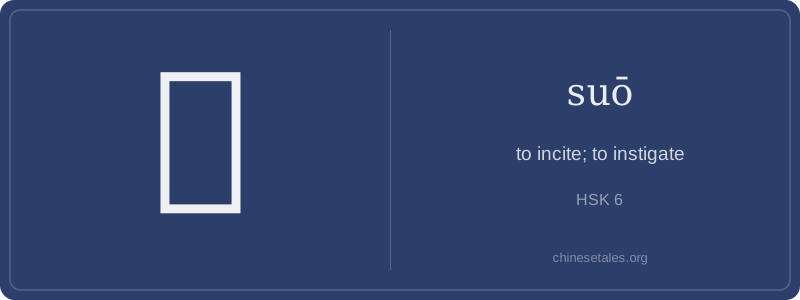
The earliest form of 唆 appears in Han dynasty clerical script, not oracle bone — it’s a relatively late-comer. Visually, it’s a brilliant piece of semantic engineering: left side 口 (kǒu, 'mouth') signals speech-related meaning, while the right side 缩 (suō, 'to shrink/contract') was borrowed purely for sound — but with uncanny resonance. Look closely: 缩 itself contains 矢 (shǐ, 'arrow') and 宿 (sù, 'to lodge'), suggesting something pointed, hidden, and lodged in place — like a whispered suggestion taking root in the mind. Over centuries, the top of 缩 simplified from 宀+龺 to the modern 丶+冖+寸, streamlining the character without losing its 'covert pressure' vibe.
This phonetic-semantic fusion wasn’t accidental. By the Tang dynasty, 唆 had crystallized as a term for stealthy verbal provocation — notably in legal documents condemning '唆讼' (suōsòng), or inciting frivolous lawsuits, seen as corrupting social harmony. In Ming dynasty vernacular fiction like *Jin Ping Mei*, 唆 appears in dialogue where maids whisper lies to turn mistresses against each other — always behind screens, half-hidden, mouth close to ear. The character’s very shape whispers: this isn’t open debate — it’s speech designed to shrink someone’s judgment and expand your control.
At its core, 唆 (suō) carries a subtle but sharp moral charge — it’s never neutral. Unlike English 'encourage' or 'suggest', 唆 always implies covert, often unethical prompting: whispering poison into someone’s ear to provoke action they wouldn’t take alone. It’s the verbal equivalent of slipping a match into a dry forest — small, quiet, but with explosive consequences. You’ll almost never see it in positive contexts; even 'advising' or 'urging' uses other characters like 劝 or 敦促.
Grammatically, 唆 is almost always transitive and requires an object (who is incited) and usually a purpose or result clause. It frequently appears in the pattern 唆使 (suōshǐ) + [person] + [verb], or in passive constructions like 被唆使. Learners often mistakenly use it intransitively ('He suōed') — but that’s ungrammatical. Also, note it’s rarely used alone in speech; native speakers prefer compounds like 唆使 or 唆摆, making standalone 唆 feel literary or even archaic.
Culturally, 唆 reflects deep-rooted Chinese skepticism toward indirect influence — especially when power imbalances are involved (e.g., a boss subtly pressuring an employee, or elders manipulating family disputes). Classical texts like the *Book of Rites* warn against ‘以言唆祸’ (using words to incite disaster), framing speech not just as expression but as social responsibility. A common learner trap? Confusing it with similar-sounding suǒ (锁, 'to lock') or sū (苏, 'to revive') — tonal mix-ups here can accidentally turn 'he incited violence' into 'he locked violence'!