唇
Character Story & Explanation
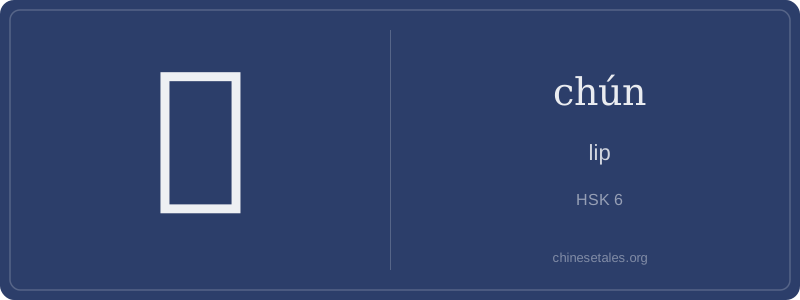
The earliest form of 唇 appears in Warring States bamboo slips (c. 475–221 BCE) — not as a pictograph of lips, but as a stylized depiction of a mouth (口) with two curved lines above and below, representing upper and lower lips in profile. Oracle bone script doesn’t contain 唇; it emerged later as a semantic-phonetic compound: 口 (kǒu, mouth) as the meaning-bearing radical, and 殿 (diàn, later simplified to 亠+厶+冖+寸) as the phonetic component — though this part evolved drastically over centuries into today’s 『辰』-like top (actually a corrupted form of 『脣』, the ancient variant). Stroke by stroke: start with 口 (3 strokes), then add the upper curve (丿), dot (丶), horizontal (一), and the complex lower component (厶 + 寸) — totaling 10 strokes that flow like the gentle arch of lips themselves.
By the Han dynasty, 唇 was already embedded in political metaphor: the *Book of Rites* warns that 'the ruler’s words are like lips — if lips tremble, teeth chatter' (君言如唇,唇动则齿寒), crystallizing the lip-tooth interdependence idea. In Tang poetry, Du Fu wrote of 'cracked lips from thirst' (唇焦口燥呼不得), using 唇 to evoke physical extremity and poetic pathos. Its visual form — mouth + delicate curves — never strayed from its embodied, intimate essence: the threshold where breath becomes voice, silence becomes speech, and self meets other.
At its core, 唇 (chún) isn’t just ‘lip’ — it’s the warm, expressive, vulnerable border between inner self and outer world. In Chinese, it carries visceral weight: think of 唇枪舌剑 (chún qiāng shé jiàn, 'lips as spears, tongue as swords') for fiery verbal combat, or 唇亡齿寒 (chún wáng chǐ hán, 'when lips perish, teeth grow cold') — a 2,500-year-old idiom from the *Zuo Zhuan* describing interdependence. Unlike English, where ‘lip’ is mostly anatomical, 唇 often appears in literary, idiomatic, or emotionally charged contexts — rarely in casual speech like 'my lip is chapped' (that’s usually 嘴唇 or 口唇).
Grammatically, 唇 is almost always bound: you’ll rarely see it alone. It pairs with 口 (kǒu) to form 嘴唇 (zuǐchún, 'mouth-lip', the standard spoken term), or with 齿 (chǐ, 'tooth') in classical compounds. Note: it’s not used for 'lipstick' (口红, kǒuhóng) or 'lip gloss' (唇彩, chúncǎi) — those are modern compound nouns where 唇 serves as a precise, elegant classifier. Learners mistakenly use 唇 alone like English 'lip' ('I bit my 唇'), but native speakers say 我咬了嘴唇 (wǒ yǎo le zuǐchún). The radical 口 (kǒu, 'mouth') anchors it firmly in the oral sphere — not the face (face is 脸, liǎn) or skin (皮肤, pífū).
Culturally, 唇 evokes intimacy and danger: sharing wine from one cup touches lips (交杯酒, jiāobēijiǔ), while 唇枪舌剑 implies rhetorical violence. A common error? Confusing it with 淳 (chún, 'pure, honest') — same sound, totally unrelated meaning and origin. Also, don’t confuse it with 纯 (chún, 'pure') — visually distinct but phonetically identical, leading to misreading classical texts.