唐
Character Story & Explanation
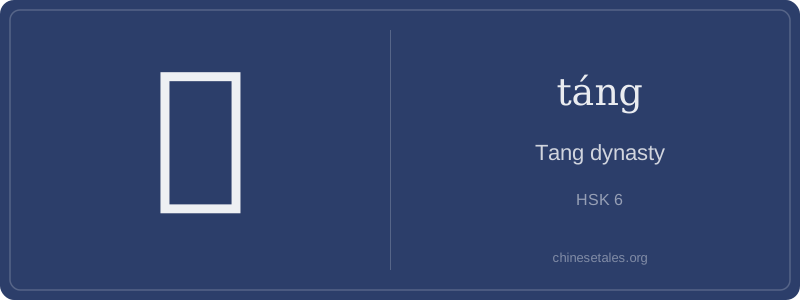
The earliest form of 唐 appears in bronze inscriptions of the Western Zhou (c. 1046–771 BCE) as a compound: the top part resembled a stylized ‘big’ or ‘vast’ element (later evolving into the 广-like shape above 口), while the bottom was 口 — not just ‘mouth’, but a symbol of speech, proclamation, or ritual utterance. Over centuries, the upper component simplified from a complex glyph representing ‘spreading out’ or ‘expansive sound’ into today’s 广 + 丶 + 一 + 一 structure, while 口 remained stable. By the seal script era, the ten-stroke balance we know was set — visually echoing authority spoken aloud.
This origin explains everything: 唐 originally meant ‘grand, imposing speech’ — think of a ruler’s solemn decree echoing in a vast hall. In the Classic of Poetry (Shījīng), 唐 is used in phrases like ‘táng táng’ (堂堂) meaning ‘majestic, imposing’. When Li Yuan founded his dynasty in 618 CE, he chose 唐 not because of geography (his base was in Taiyuan, anciently called ‘Táng’), but because the character already carried connotations of solemn dignity and resonant authority. The visual rhythm — wide upper frame over the mouth — became a silent emblem: power that speaks clearly, widely, and with weight.
At first glance, 唐 (táng) feels like a quiet, dignified word — it’s the name of China’s golden-age dynasty (618–907 CE), evoking poetry, cosmopolitan Chang’an, and the confident openness that made Tang culture resonate across Asia. But here’s what learners often miss: 唐 isn’t just historical — it’s alive in modern speech with gentle irony. When someone says ‘táng huáng’ (唐皇), they’re not praising an emperor; they’re teasing a friend for acting overly grandiose. That playful layer reveals how Chinese speakers repurpose classical weight as social lubricant — reverence and ribbing share the same character.
Grammatically, 唐 rarely stands alone outside proper nouns. You’ll see it in compounds like 唐朝 (Táng cháo, ‘Tang dynasty’) or 唐装 (Táng zhuāng, ‘Tang-style clothing’), but never as a verb or adjective by itself. Crucially, it’s *not* used to mean ‘Chinese’ broadly — that’s 汉 (hàn) or 中 (zhōng). A common mistake is saying ‘táng rén’ for ‘Chinese people’; the correct term is 唐人 only in specific contexts like ‘Chinatown’ (唐人街, Táng rén jiē), where it preserves historical diaspora usage — not modern nationality.
Culturally, 唐 carries soft power: Japanese still call Chinese writing ‘kara-moji’ (from 唐), Korean scholars studied Tang legal codes, and Persian merchants in Xi’an spoke of ‘Da Tang’. Yet ironically, the character itself has no intrinsic meaning related to ‘dynasty’ — its original sense was ‘great’, ‘vast’, even ‘boastful’, which later attached to the ruling house. That semantic drift — from ‘lofty speech’ to ‘golden age’ — shows how Chinese values honor both rhetorical brilliance and historical resonance in one stroke.