啦
Character Story & Explanation
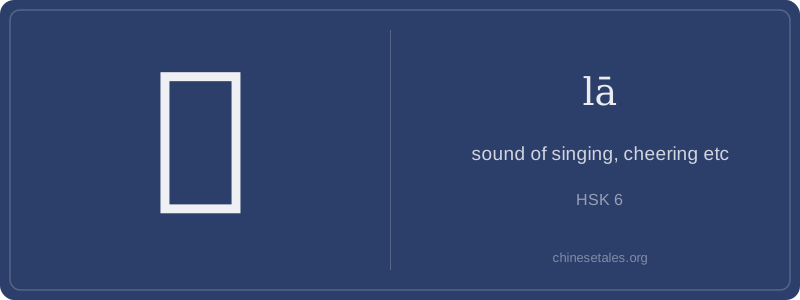
The character 啦 evolved from two ancient components: 口 (kǒu, ‘mouth’) as the radical—always signaling speech, sound, or vocalization—and 拉 (lā, ‘to pull’) as the phonetic component. In seal script (c. 3rd century BCE), the right side resembled a hand gripping a rope—depicting effortful pulling. Over centuries, the rope simplified into the modern 拉’s ‘hand’ (扌) plus ‘stand’ (立), while the mouth radical remained steadfastly front-and-center. By the Tang dynasty, the full character appeared in poetry manuscripts as a phonetic loan for expressive utterance—not yet grammaticalized, but already humming with vocal energy.
Its semantic shift mirrors China’s evolving oral culture: early uses in Yuan dynasty zaju operas marked crowd chants and improvised comic asides; by Qing-era vernacular novels like Flowers in the Mirror, 啦 began signaling light epiphanies or group affirmation—never solemn, always social. The visual logic is deliciously literal: 口 + 拉 = ‘mouth pulling forth sound’—as if your voice is being drawn out, not forced, but released like a plucked string. That ‘pulling’ motion explains why 啦 feels dynamic, forward-moving, never static—it’s language in motion, voiced in community.
‘啦’ isn’t just a sound—it’s Chinese emotional punctuation in action. Think of it as the exclamation point with breath, the smile that escapes before you finish the sentence. It conveys spontaneous joy, collective enthusiasm, or light-hearted realization—like the cheer at a basketball game, the sigh of relief when rain finally stops, or the playful ‘aha!’ after solving a riddle. Crucially, it’s not a standalone word but a sentence-final particle: it attaches to verbs or adjectives to add warmth, immediacy, and shared feeling (e.g., ‘快走啦!’ — ‘Let’s go already!’). Unlike English interjections, 啦 never stands alone—it rides the rhythm of the clause like a musical grace note.
Grammatically, 啦 is a fusion of ‘了’ (le, indicating change/completion) + ‘啊’ (a, a modal particle for softening or emotive coloring). So its pronunciation lā reflects this blend—but don’t confuse it with the neutral-tone ‘la’ (e.g., in ‘你好啊’ → nǐ hǎo a), where the tone drops. Learners often overuse 啦 as a generic ‘yeah!’ or ‘okay!’—but native speakers reserve it for moments charged with communal energy or gentle urgency. Using it after dry facts (‘北京是中国的首都啦’) sounds jarringly childish or sarcastic.
Culturally, 啦 reveals how Chinese grammar encodes relationality: meaning isn’t just in the words, but in how they’re *delivered*—with shared breath, timing, and affect. It’s the linguistic equivalent of leaning in, grinning, and nudging your friend’s arm. Misplacing it betrays a lack of tonal intuition—not vocabulary ignorance. And fun fact: in Mandarin pop songs and livestreams, 啦 appears more than any other particle in chorus hooks, precisely because it’s the easiest syllable to sing with open mouth and lifted spirit.