喇
Character Story & Explanation
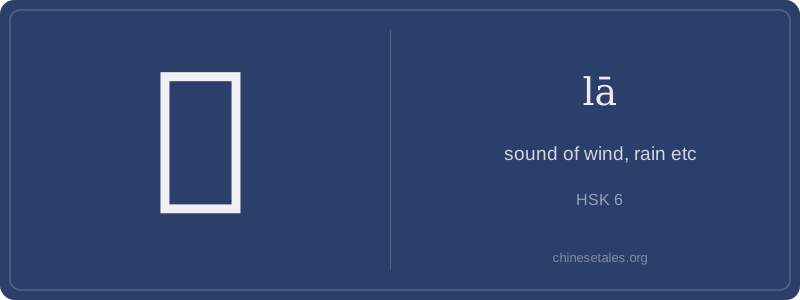
The earliest form of 喇 appears in late Warring States bamboo texts as a variant of 吶 (nà), itself derived from 口 + 納 (nà, 'to receive'). Visually, it began as 口 (mouth/sound) + 刑 (xíng, 'punishment', later simplified to 朿-like strokes), but by the Han dynasty, scribes streamlined it into 口 + 剌 (là, 'to stab' — suggesting sharp, piercing sound). Over centuries, the right-hand component softened: the 'knife' (刂) merged with the 'wood' (木) base, evolving into today’s 喇 — twelve strokes total, with the top two dots (丶丶) representing sound waves bursting outward from the mouth.
This evolution mirrors its semantic journey: from classical references to loud, urgent cries (e.g., in the *Zuo Zhuan*, soldiers shouting 喇喇 before charge) to Tang poetry evoking wind ‘whistling through broken eaves’ (喇喇穿牖), and finally to Ming-Qing vernacular fiction where 喇啦 described rain hammering roofs or silk tearing sharply. The character’s mouth radical isn’t decorative — it anchors the idea that this sound originates *from the body*, not the environment. Even today, when writers use 喇喇, they’re invoking visceral human perception, not abstract acoustics.
Imagine hearing wind rush through a canyon — not just the sound, but the raw, hollow, resonant *whoosh* that vibrates in your chest. That’s 喇 (lā): not a word you define with a dictionary entry, but one you *feel* — an onomatopoeic character capturing gusts, downpours, distant horns, or even chaotic chatter. It doesn’t stand alone as a noun or verb; it’s almost always part of reduplicated sound-words like 喇喇 (lā lā) or 喇啦 (lā lā), functioning as an adverbial modifier to intensify motion or noise — think 'rustling furiously' or 'raining torrentially'. You’ll rarely see it unpaired: saying just '喇' sounds like cutting off a sneeze mid-exhale.
Grammatically, 喇 is a classic HSK 6 stealth learner — it hides in compound onomatopoeias and mimetic expressions, often attached to verbs or adjectives. In '风喇喇地刮着' (fēng lā lā de guā zhe), the 喇喇 doesn’t mean 'wind'; it *embodies* how the wind behaves — sharp, rhythmic, unrelenting. Learners mistakenly treat it like a standalone noun ('the sound of lā'), but it’s purely functional: no meaning without repetition, no grammar without context. It’s never used in formal writing or speech — only in vivid narrative, dialogue, or literary description where sensory immediacy matters.
Culturally, 喇 belongs to Chinese’s rich sonic lexicon — alongside 啪 (pā), 咚 (dōng), and 哗 (huā) — but stands out for its breathy, open-mouthed quality (notice the 口 radical!). A common trap? Confusing it with 拉 (lā, 'to pull') because of identical pinyin — but they share zero semantic ground. Also, avoid overusing it: native speakers deploy 喇 sparingly, like spice — too much dulls the effect. Its power lies in authenticity, not frequency.