喧
Character Story & Explanation
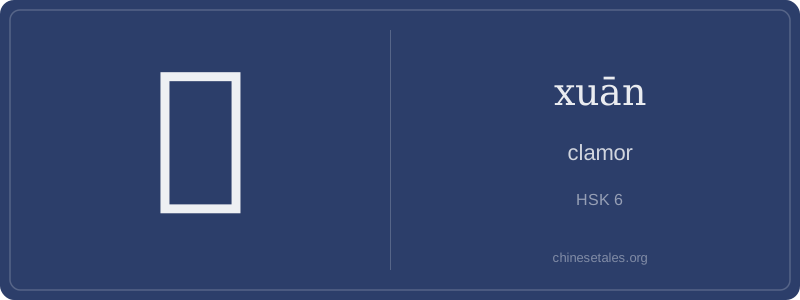
The earliest form of 喧 appears in seal script as 口 + 宣 — no pictograph, but a clear phonosemantic compound. The left side 口 (mouth) signals speech/sound; the right side 宣 (xuān), originally depicting a person standing on a raised platform proclaiming edicts (宀 = roof, 糸 = ceremonial banner, 一 = platform), provided both pronunciation and semantic resonance: public, amplified, authoritative utterance. Over time, the banner element evolved into the simplified 亘-like shape in modern 喧 — a subtle visual echo of something unfurling, spreading, echoing outward.
This duality — official proclamation morphing into chaotic public noise — reveals how meaning shifted across dynasties. In the Shuōwén Jiězì (2nd c. CE), 喧 was defined as ‘shouting loudly’ (大聲也), but by Tang poetry, it carried irony: Li Bai used 喧 in ‘车马喧’ (clatter of carriages and horses) to contrast worldly bustle with reclusive peace. The character’s visual rhythm — 12 strokes, balanced yet restless, with the ‘mouth’ anchoring the energetic sweep of 宣 — mirrors its semantic tension: sound that begins with intent but spirals into communal disruption.
Think of 喧 (xuān) as the Chinese equivalent of 'white noise' — not just loudness, but a layered, overlapping, socially charged din: street vendors shouting over bus announcements while construction drills whine in the background. It’s never neutral; it implies *disruptive* or *unruly* sound, often with a tinge of chaos or social friction — like the clamor of a protest, a crowded market, or an argument spilling into a hallway. Unlike generic ‘loud’ words (e.g., 大声), 喧 always carries semantic weight: it’s about *collective*, *intrusive* sound that breaks calm or decorum.
Grammatically, 喧 is almost never used alone. You’ll rarely say ‘this is xuān’ — instead, it appears in fixed compounds (喧闹, 喧哗) or as part of literary verbs like 喧腾 (to surge noisily) or 喧嚷 (to shout insistently). It can function as a verb (e.g., 人群喧了起来 — ‘the crowd grew clamorous’) or, more commonly, as the descriptive core of a compound adjective. Learners often mistakenly use it as a standalone adjective like ‘noisy’, but it resists that role — it’s inherently relational and contextual, requiring a social or environmental frame to make sense.
Culturally, 喧 evokes Confucian ideals of quietude and restraint: the ideal scholar ‘speaks little and listens much’ (少言寡语), so 喧 subtly signals deviation from harmony — think of the sharp contrast between the serene stillness of a Zen garden and the jarring 喧 outside its gate. A classic mistake is confusing it with 嚷 (rǎng), which is more about individual shouting; 喧 is ambient, collective, atmospheric. It’s the sound you *feel* in your ribs before you even hear it.