丧
Character Story & Explanation
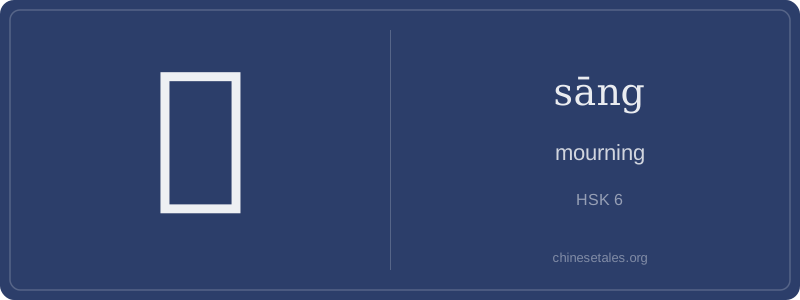
The earliest form of 丧 appears in Western Zhou bronze inscriptions as a pictograph showing a person kneeling beside a corpse under a roof — a clear depiction of mourning rites within a home. Over time, the roof (宀 mián) simplified into the top two dots and horizontal stroke, the kneeling figure became the 十-like cross (originally representing arms raised in lament), and the corpse evolved into the lower 十 radical — though modern analysis reclassifies that lower 十 as a phonetic component borrowed from 亡 (wáng, ‘to perish’), not the meaning-bearing radical. The current 8-stroke form crystallized in the clerical script, where symmetry and balance overrode pictographic clarity — yet the somber verticality remains.
This character was already central in the *Book of Rites* (Lǐjì), prescribing precise durations for mourning periods based on kinship distance — three years for parents, one year for grandparents. Confucius himself emphasized that proper 丧 wasn’t about emotion, but about embodying ritual sincerity (诚 chéng): ‘If the heart does not grieve, then the mourning dress is meaningless.’ Interestingly, the lower 十 radical, though now classified as ‘ten’, originally echoed the shape of a bound corpse — a visual echo of containment and cessation. Even today, calligraphers pause before writing 丧, knowing each stroke must descend like a sigh.
At its core, 丧 (sāng) isn’t just ‘mourning’ — it’s the formal, ritualized, deeply Confucian weight of loss: the white mourning clothes, the three-year period of withdrawal, the ancestral tablets draped in black. It’s not sadness (悲伤 bēishāng) or grief (悲痛 bēitòng); it’s the *institutional framework* around death — so much so that it appears almost exclusively in set phrases, classical allusions, or bureaucratic contexts (e.g., 丧事 shì — ‘funeral affairs’). You’ll rarely hear it in casual speech; saying ‘I’m mourning’ as a standalone verb sounds archaic or theatrical.
Grammatically, 丧 functions almost always as a noun or noun modifier — never as a standalone verb meaning ‘to mourn’. Learners mistakenly try to say *wǒ zài sāng* (‘I am mourning’), but that’s ungrammatical. Instead, you use verbs like 哀悼 (āidào) or 悼念 (dàoniàn), while 丧 anchors compounds: 丧服 (sāngfú, ‘mourning attire’), 举丧 (jǔsāng, ‘to hold funeral rites’). Note the tone shift: when used in verbs like 丧失 (sàngshī, ‘to lose’), it becomes sàng — a semantic extension from ‘ritual loss’ to ‘deprivation’, but this is a different lexical item entirely.
Culturally, 丧 carries profound taboos: it’s avoided in weddings, business openings, and even New Year greetings — its presence is considered inauspicious. Learners often mispronounce it as sàn or sǎng, or confuse it with similar-looking characters like 丧 vs. 丧 (yes, same form — but note the tone! sāng = mourning, sàng = to lose). Also, don’t write it on red paper — ever. Its very shape evokes stillness and finality, and in traditional calligraphy, the downward strokes are written with deliberate heaviness, like lowering a coffin.