喻
Character Story & Explanation
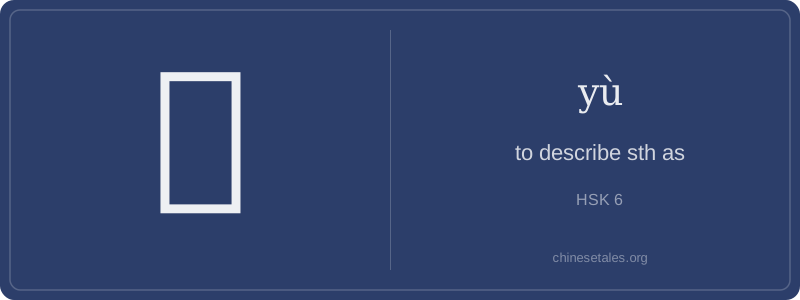
The earliest form of 喻 appears in Warring States bamboo slips — not as a pictograph, but as a phonosemantic compound. Its left side 口 (kǒu, 'mouth') signals speech-related meaning, while the right side 俞 (yú), originally depicting a boat passing smoothly through a narrow gate (舟 + 月 + 刂), provided both sound and the idea of 'effortless passage' — suggesting words that glide understanding into the mind. Over centuries, 俞 simplified: the boat (舟) became 人 + 一 + 月, then further stylized to 俞, and the whole character stabilized by the Han dynasty with its current 12-stroke form.
This visual logic deepened its meaning: if words are vessels, 喻 is the skillful navigation of meaning from speaker to listener. In the Mencius, 喻 becomes central to moral teaching — not by decree, but by relatable comparison ('Is it any different when a ruler neglects his people than when a cook throws away good meat?'). Later, in Tang poetry and Song essays, 喻 evolved from 'to liken' to underpin entire rhetorical strategies: the 'implied analogy' (暗喻, ànyù) and 'extended metaphor' (博喻, bóyù) both derive their names from this root. Its mouth radical reminds us: this is never silent thought — it’s spoken insight made vivid.
Think of 喻 (yù) as Chinese’s elegant version of the English verb 'to liken' — not just 'to say something is X,' but to artfully draw a parallel, like Shakespeare calling time 'a thief' or a poet comparing sorrow to 'a heavy stone.' It’s less about literal equivalence and more about illuminating essence through analogy. In classical and literary Chinese, 喻 almost always appears in the structure 'A 喻 B 为 C' ('A likens B to C') — e.g., '他喻人生为旅途' (He likens life to a journey). Modern usage is rarer in speech but thrives in formal writing, rhetoric, and idioms.
Grammatically, 喻 is nearly always transitive and requires an explicit object and a 'as/like' complement — you can’t just say '他喻了' (✗); it must be '他喻此理为明灯' (✓). Learners often mistakenly substitute it for 比喻 (bǐyù, 'metaphor') or use it like the casual verb 说 ('say'), leading to unnatural sentences. Also, note: 喻 is never used for 'to explain' — that’s 解释 (jiěshì) or 阐明 (chǎnmíng).
Culturally, 喻 carries the weight of Confucian pedagogy and Daoist imagery: Mencius famously used analogies (喻) to make ethics tangible — comparing benevolence to water flowing downhill. Today, its rarity in daily talk makes it a stylistic marker: spotting 喻 signals literary sophistication, like hearing 'whence' or 'hither' in English prose. Overusing it sounds archaic; avoiding it entirely misses a key tool for persuasive, vivid expression at HSK 6 level.