嗨
Character Story & Explanation
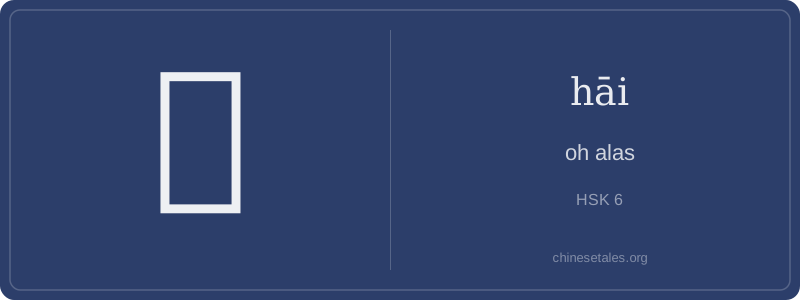
嗨 has no ancient oracle bone or bronze script form — it’s a latecomer, born in the late Qing and early Republican era as a phonetic loan character. Its components tell the tale: the left 口 (kǒu, 'mouth') signals vocalization, while the right 海 (hǎi, 'sea') is purely phonetic — chosen because its pronunciation (hǎi) was close enough to the desired interjectional sound 'hāi'. Over time, the third tone shifted to the first for expressive emphasis, and the 海 component simplified visually: its 每 (měi) top became 亠 (tóu), and the 母 (mǔ) base condensed into the compact +丨+一 shape we see today — 13 strokes total, all serving sound over semantics.
This character didn’t evolve — it was *invented*. Unlike most Chinese characters with millennia of semantic drift, 嗨 entered the language as a deliberate onomatopoeic tool, mimicking the drawn-out, downward exhalation of disappointment. Early 20th-century vernacular fiction (like Lu Xun’s dialogues) used it sparingly for realistic speech rhythm; by the 1980s, it gained traction in film subtitles and youth magazines. Its visual link to 海 ('sea') is coincidental — yet poetically apt: like staring at the sea, 嗨 evokes vast, quiet, slightly melancholy contemplation.
At first glance, 嗨 (hāi) looks like a cheerful 'hi!' — and indeed, it *can* be used that way in modern spoken Chinese, especially among young people imitating English 'hey!' But its HSK 6 meaning 'oh alas' reveals its true soul: a sigh of resignation, disappointment, or wry self-awareness. Think of it as the verbal equivalent of a slow blink and a shoulder slump — not anger, not tears, but the quiet, breathy release after a plan collapses or irony hits hard.
Grammatically, 嗨 is an interjection — always sentence-initial, never followed by a verb or object. It stands alone or leads a clause, often before a subject + predicate structure: Hāi, zhè shì shénme qíngkuàng a? ('Oh alas, what on earth is this situation?'). Learners mistakenly attach it to verbs ('*hāi le') or use it mid-sentence — a no-no. Unlike 啊 (a) or 哎 (āi), 嗨 carries zero warmth or inquiry; it’s emotionally heavy, even when delivered lightly.
Culturally, 嗨 thrives in ironic, self-deprecating speech — think stand-up comedy, WeChat rants, or Gen-Z venting. Its tone is distinctly urban and contemporary; you won’t find it in classical poetry or formal documents. A common mistake? Confusing it with 嘿 (hēi) — which *is* genuinely friendly — or misreading its mouth radical (口) as indicating speech *about* something, rather than the physical *act* of exhaling that sigh. Remember: 嗨 isn’t said *to* someone — it’s breathed *out*, alone.