慨
Character Story & Explanation
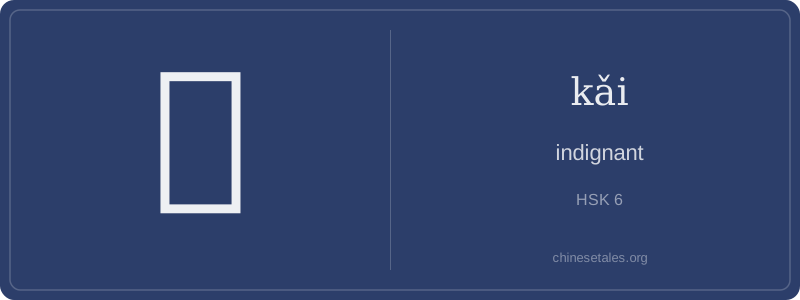
The earliest form of 慨 appears in seal script, built from 忄 (the ‘heart-mind’ radical, indicating emotion) on the left and 既 (jì, meaning ‘already’ or ‘having completed’) on the right. But don’t be fooled — 既 wasn’t chosen for meaning here. Its role was phonetic: in Old Chinese, 既 sounded close to *kʰˤrəp, helping signal the ‘kǎi’ pronunciation. Visually, the modern 12-stroke form preserves that structure: three dots (representing the heart’s pulsing energy), then the clean, decisive strokes of 既 — its horizontal lines like a furrowed brow, its downward stroke like a sigh released.
This character first appeared in Warring States bamboo texts and matured in Han dynasty literature, where it consistently expressed noble emotional response — especially grief mixed with moral protest. Sima Qian’s Records of the Grand Historian uses 慨 in passages describing loyal ministers sighing at court corruption. Crucially, the ‘heart + already’ composition subtly implies emotion that has *already taken hold* — not fleeting anger, but deep, settled, unignorable feeling. That sense of inevitability and weight still defines 慨 today: it’s not what you feel in the moment — it’s what remains after reflection, echoing in your chest like a struck bronze bell.
At its heart, 慨 (kǎi) isn’t just ‘indignant’ — it’s the visceral, chest-tightening surge of moral outrage: the kind you feel watching injustice unfold and instinctively clench your jaw or sigh sharply. It’s deeply emotional, often noble-sounding, and almost always tied to ideals — fairness, loyalty, integrity — rather than petty annoyance. You’ll rarely hear it in casual speech; it lives in essays, speeches, historical narratives, and literary laments.
Grammatically, 慨 is nearly always used in compounds (like 感慨 or 慷慨), not alone. As a standalone verb, it appears only in formal, classical-style expressions like ‘慨然’ (kǎi rán — ‘with righteous resolve’) or in set phrases like ‘慨叹’ (kǎi tàn — ‘to sigh with sorrowful indignation’). Learners often mistakenly try to use it like ‘angry’ (生气) — but 慨 carries no aggression; it’s sorrow-tinged, dignified, and inwardly resonant. Think less ‘I’m mad!’ and more ‘How can this be?’ whispered with heavy heart.
Culturally, 慨 reflects Confucian values: indignation isn’t selfish rage — it’s evidence of cultivated virtue and social conscience. That’s why classical texts praise the ‘junzi who 慨然赴义’ (a noble person who resolutely upholds righteousness). A common learner trap? Overusing it in spoken Chinese — it sounds archaic or theatrical outside formal writing. Also, watch tone: kǎi (third tone) is easily mispronounced as kāi (first tone), which means ‘to open’ — imagine declaring ‘I’m indignant!’ when you meant ‘I’m opening the door!’