叹
Character Story & Explanation
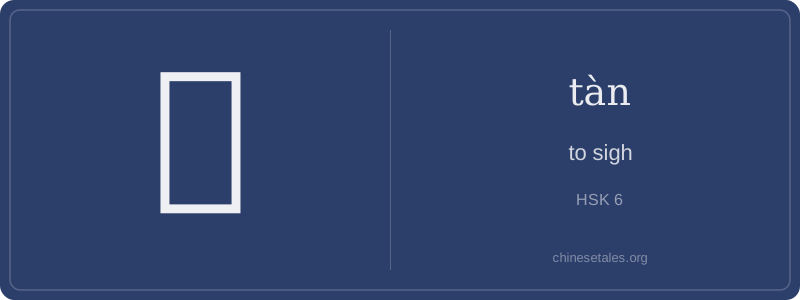
The earliest form of 叹 appears in bronze inscriptions as a combination of 口 (kǒu, ‘mouth’) and 天 (tiān, ‘heaven’) — not the modern 欠. That ancient shape depicted a person standing upright, mouth open wide, head tilted upward toward heaven — literally ‘voicing to the sky’. Over centuries, 天 simplified into 欠 (qiàn), a component meaning ‘to lack’ or ‘to yawn’, reinforcing the idea of an involuntary, breath-driven vocalization. By the seal script era, the structure stabilized: 口 on the left, 欠 on the right — five clean strokes capturing the physical act of sighing as both bodily gesture and spiritual utterance.
This visual logic shaped its semantic journey: from oracle-bone ritual cries to classical expressions of deep feeling. In the Book of Songs, 叹 appears in lines like ‘慨叹’ (kǎi tàn, ‘to lament with feeling’), where it conveys moral sorrow. Later, in Su Shi’s poetry, 叹 shifts toward awe — ‘叹为观止’ (tàn wéi guān zhǐ, ‘so astonishing it stops your gaze’). Crucially, the character never lost its dual nature: the mouth provides the channel, the ‘lacking’ component (欠) hints at emotional absence — a sigh born from what’s missing, unattainable, or overwhelming.
Think of 叹 (tàn) as Chinese literature’s equivalent of a dramatic stage sigh — not just air escaping your lungs, but a full-body punctuation mark for emotion: regret, awe, resignation, or wonder. Unlike English ‘sigh’, which often implies sadness, 叹 can be profoundly positive: you 叹服 (tàn fú) — ‘sigh in admiration’ — when someone’s brilliance leaves you breathless. It’s the sound of your soul hitting pause.
Grammatically, 叹 is rarely used alone as a verb in modern speech (you won’t say ‘I sighed’ as *wǒ tàn*); instead, it lives inside compound verbs (叹气, 叹服, 叹息) or literary expressions. Its most elegant use is as a transitive verb meaning ‘to exclaim with emotion’: 他叹道… (tā tàn dào…) — ‘He sighed and said…’, introducing quoted speech charged with feeling. Learners often mistakenly use it like English ‘sigh’ intransitively — but 叹 needs emotional weight, context, or a complement to land right.
Culturally, 叹 carries classical gravitas — it appears in Tang poetry and Ming novels to signal moral reflection or cosmic irony. A common error? Confusing it with 喝 (hē, ‘to drink’) or 吸 (xī, ‘to inhale’) — but 叹 isn’t about intake or consumption; it’s about *release with resonance*. It’s the audible exhale of the heart, not the lungs — and that distinction is everything.