哗
Character Story & Explanation
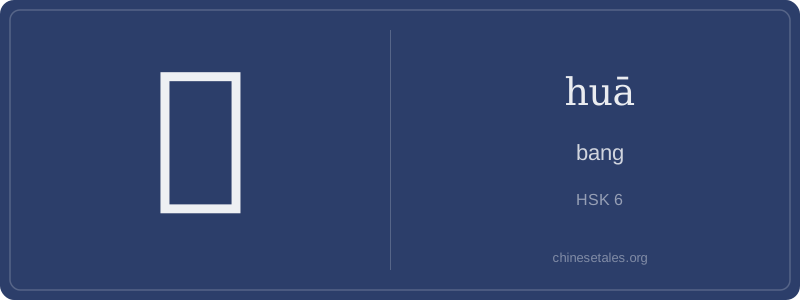
The earliest form of 哗 isn’t found in oracle bones, but its components tell a vivid story. The left side 口 (kǒu, ‘mouth’) is classic for speech- and sound-related characters. The right side is 华 (huá), originally a pictograph of blooming flowers (hua) — later stylized into today’s 华. In 哗, 华 wasn’t borrowed for ‘flower’ but for its *sound*: it served as a phonetic component, hinting at pronunciation (huá/huā). Over centuries, the flower’s intricate branches simplified into the clean strokes we see: the top dot, then the cross-shaped ‘hua’ structure beneath — all nine strokes flowing like a sudden burst of petals exploding outward from the mouth.
This visual fusion — mouth + floral explosion — perfectly mirrors its semantic evolution. In classical texts, 哗 appears rarely as onomatopoeia, but by the Ming and Qing dynasties, it flourished in vernacular novels (like *Water Margin*) to punctuate dramatic action: ‘只听哗的一声,门开了’ — ‘Suddenly, *huā!* — the door flew open.’ Here, the ‘flower’ component subtly reinforces the idea of something blossoming *instantly* into noise — not gradual rumble, but a radiant, attention-seizing flash of sound. Even today, the character feels less like a description and more like a tiny firework written in ink.
At its heart, 哗 (huā) is a sonic explosion — not a word you read, but one you *feel* in your eardrums. It’s an onomatopoeic interjection, capturing the sharp, sudden burst of sound: a door slamming, glass shattering, or fireworks detonating. Unlike descriptive adjectives like 响 (loud), 哗 doesn’t describe volume — it *recreates* the acoustic event itself, often with theatrical flair or mild alarm. You’ll hear it in exclamations ('哗!') or embedded in reduplicated forms like 哗啦啦 (huālālā) for cascading sounds.
Grammatically, it’s delightfully flexible: as an interjection (‘Huā! The vase just fell!’), as an adverb modifying verbs (‘哗地一声撕开’ — ‘ripped open with a *bang!*’), or in fixed compounds like 哗变 (huábiàn, ‘mutiny’ — literally ‘sudden clamor-turn’). Crucially, learners often misread it as huá (like 华), especially in words like 哗众取宠 (huázhòngqǔchǒng, ‘to court popularity with flashy gimmicks’) — where the *huá* reflects ‘clamorous showiness’, not ‘bang’. That’s the second pronunciation: huá appears only in literary/multisyllabic words meaning ‘noisy, showy, sensational’ — never in standalone onomatopoeia.
Culturally, 哗 carries performative energy: it’s the sound of attention-grabbing — think street performers, political rallies, or a child dropping a tray to shock adults into noticing. A common mistake? Using it where English uses ‘boom’ or ‘crash’ without matching the Chinese context: ‘boom’ is more often 轰 (hōng), while 哗 implies brevity, sharpness, and often human agency — not thunder or earthquakes. Mastering it means tuning your ear to the rhythm of Chinese sound symbolism, not just memorizing tones.