嘛
Character Story & Explanation
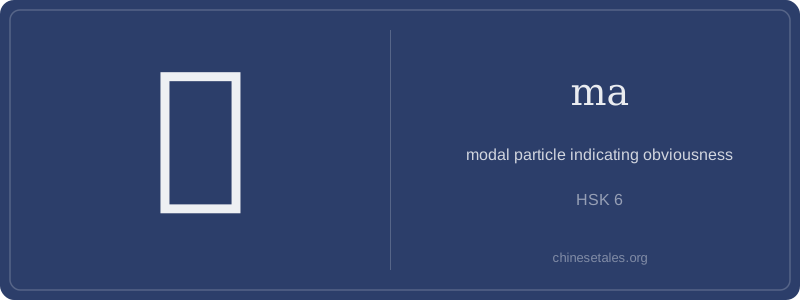
嘛 has no ancient pictographic origin — it’s a latecomer, born from phonetic borrowing during the late imperial period. Its components tell the tale: left side 口 (kǒu, ‘mouth’) signals it’s a spoken particle; right side 馬 (mǎ, ‘horse’) is purely phonetic, chosen because its Middle Chinese pronunciation (*mæX*) closely matched the colloquial particle’s sound. Over centuries, 馬 simplified visually — its four dots became three strokes, the horizontal stroke shortened, and the lower part condensed — until it settled into today’s 14-stroke form. No horses were harmed, no mouths were shaped like hooves: it’s pure sound-symbol marriage.
The meaning emerged organically from speech rhythm and social pragmatics. In Ming-Qing vernacular fiction like Golden Lotus, particles like 嘛 began appearing in dialogue to mark speaker alignment — not new information, but shared assumptions. By the 20th century, it crystallized as the quintessential ‘obviousness’ marker, especially in Northern Mandarin. Visually, the mouth radical anchors it firmly in orality, while 馬 — though silent in meaning — subtly echoes the ‘ma’ sound like a mnemonic drumbeat. Its modern shape is less a picture than a phonetic fingerprint: written speech made visible.
嘛 (ma) is the linguistic equivalent of raising your eyebrows and giving a little shrug — it’s not just grammar, it’s attitude. It signals that something is self-evident, almost too obvious to state: 'Well, of course!' or 'What did you expect?' It carries warmth, mild exasperation, or gentle teasing — never cold logic. Unlike English ‘obviously’, which can sound dismissive, 嘛 softens assertions by inviting shared understanding: it presumes common ground, not superiority.
Grammatically, 嘛 sits at the end of statements (never questions or commands), often after pronouns, nouns, or verbs. It frequently appears in conversational repetition for emphasis: ‘Nǐ shì xuéshēng ma? — Shì ma!’ (‘Are you a student?’ — ‘Well, of course I am!’). Crucially, it’s never used in formal writing or speeches — it’s strictly oral, intimate, and relational. Learners often overuse it trying to sound ‘natural’, but native speakers deploy it sparingly, like seasoning: one pinch transforms tone; two makes it cloying.
Culturally, 嘛 reveals how Chinese communication values harmony through implied consensus. Rather than asserting facts baldly, 嘛 wraps truth in shared context — a quiet nod to mutual experience. Misusing it (e.g., with strangers or in emails) risks sounding condescending or unprofessional. And beware: while it’s *almost always* pronounced mā (first tone) in this modal sense, it *can* be read as má (second tone) in rare dialectal interjections — but for HSK 6, stick to mā. Your ear should hear it like a soft, knowing ‘mm-hmm’ — not a question, not a command, just belonging.