呕
Character Story & Explanation
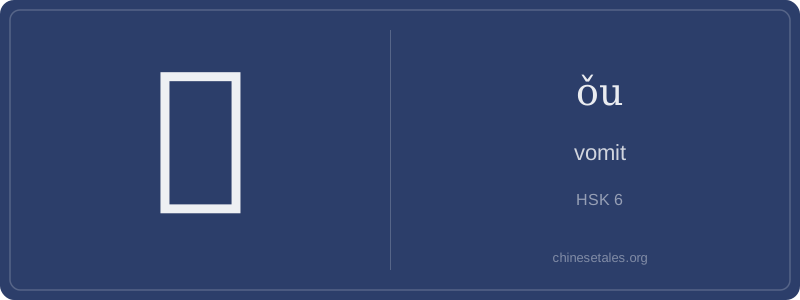
The earliest known form of 呕 appears in Han dynasty clerical script, not oracle bone — because vomiting wasn’t recorded as a standalone pictograph in early divination. Instead, it emerged as a phono-semantic compound: 口 (kǒu), the mouth radical, added to 区 (qū), which originally depicted a curved container or enclosed space (like a bent arm holding something). In seal script, 区 looked like a coiled vessel — evoking the stomach’s constriction and the forced ejection upward through the mouth. Over centuries, 区 simplified: its top became the inverted 'U' shape (匚), and the inner stroke (× or 十) evolved into the diagonal and dot we see today — seven clean strokes total, mirroring the abrupt, jolting motion of vomiting.
This visual logic deepened in meaning: by the Tang dynasty, 呕 appeared in poetry not just for literal sickness, but for moral or aesthetic recoil — Du Fu wrote of ‘呕哑’ (ǒu yā), the harsh, grating sound of boatmen’s chants, linking auditory discomfort with visceral rejection. Later, Song scholars used 呕 in metaphors for mental labor so intense it felt physically draining — paving the way for the idiom 呕心沥血. The character didn’t just depict vomiting; it became a linguistic vessel for any forceful, painful, embodied release — of matter, sound, or spirit.
At its core, 呕 (ǒu) is visceral — it’s the body’s urgent, involuntary expulsion of stomach contents, and the character itself feels like a physical lurch. The 口 (mouth) radical anchors it in the realm of bodily orifices and vocal expression, while the right side, 区 (qū), isn’t just decorative: it’s a phonetic component that hints at pronunciation (ǒu sounds close to qū in ancient layers) *and* subtly evokes containment, restriction, and sudden release — think of the gut ‘clenching’ before vomiting. This duality makes 呕 unusually expressive: it’s not neutral like 吐 (tǔ, 'to spit' or 'to vomit' in broader contexts); 呕 carries a sharper, more distressing, often nauseating connotation.
Grammatically, 呕 is almost always used as a verb — frequently in compound verbs like 呕吐 (ǒu tù) or reduplicated forms like 呕呕 (ǒu ǒu) for onomatopoeic effect. It rarely stands alone in modern speech (you wouldn’t say *‘tā ǒu le’* without context or a complement); instead, it appears in tightly packed phrases: 呕出 (ǒu chū, 'to vomit out'), 呕心沥血 (ǒu xīn lì xuè, 'to pour one’s heart and soul into something' — literally 'vomit heart, drip blood'). Learners often mistakenly use 呕 where 吐 suffices — but that misstep can unintentionally inject grotesque intensity into an otherwise mundane sentence!
Culturally, 呕 appears in classical medical texts (e.g., the *Huangdi Neijing*) to describe pathological qi reversal, and its extended use in idioms reveals Chinese thought: turning physical trauma into metaphor for emotional or intellectual sacrifice. A common learner trap? Overusing it in writing — native speakers reserve 呕 for high-impact contexts (illness, revulsion, or literary exaggeration), never for casual spitting or mild nausea.