嚷
Character Story & Explanation
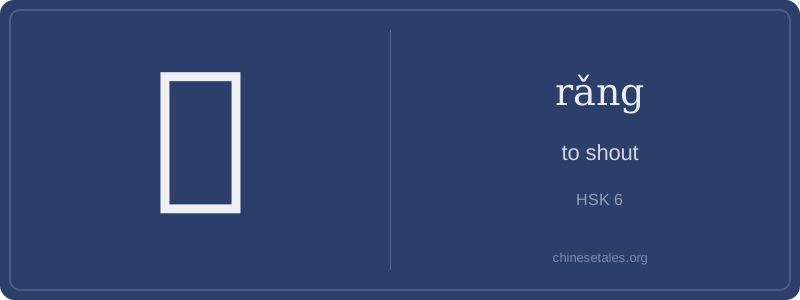
The earliest form of 嚷 appears in seal script (c. 3rd century BCE), built around the radical 口 (mouth), with the right side evolving from the phonetic component 攘 (rǎng, ‘to push aside’). Visually, it’s a mouth (口) literally ‘pushing’ — not with hands, but with forceful breath. Over centuries, the left 口 stayed stable, while the right side condensed from 攘’s full 20-stroke form into the streamlined 14-stroke structure we see today: the top 尚 (shàng, ‘still, yet’) suggests persistence, and the bottom 攵 (pū, ‘to strike’) implies percussive impact — together, they evoke repeated, striking vocalizations.
This visual logic mirrors its semantic evolution: in early texts like the *Shuōwén Jiězì* (121 CE), 嚷 was defined as ‘shouting with urgency’, linked to collective outcry (e.g., crowds 嚷着要见官 — ‘shouting to see the magistrate’). By the Ming and Qing dynasties, its reduplicated form 嚷嚷 appeared in vernacular novels like *The Plum in the Golden Vase*, signaling petty, repetitive complaints — a shift from public protest to private grumbling. The character’s 20 strokes themselves feel like a ‘vocal workout’: long, winding, demanding effort — perfectly mirroring the exhausting act of shouting until hoarse.
At its core, 嚷 isn’t just ‘to shout’ — it’s the sound of urgent, unfiltered human emotion bursting out: frustration, protest, or exasperated insistence. Unlike the neutral 吵 (chǎo, ‘to quarrel’) or the formal 宣 (xuān, ‘to proclaim’), 嚷 carries a visceral, almost physical quality — you can *feel* the throat tightening and air rushing out. It’s rarely used alone; it almost always appears in compounds like 叫嚷 (jiào rǎng) or 大嚷 (dà rǎng), and frequently with onomatopoeic reduplication (嚷嚷 rǎng rǎng), which softens it into ‘to grumble’ or ‘to chatter noisily’ — a subtle but crucial shift from anger to mild annoyance.
Grammatically, 嚷 is almost never transitive without an object marker or complement: you don’t ‘shout *a word*’ with 嚷 — you 嚷出来 (rǎng chūlái, ‘shout out’), 嚷道 (rǎng dào, ‘shouted, saying…’), or 嚷个不停 (rǎng gè bù tíng, ‘shout nonstop’). Learners often mistakenly use it like English ‘shout’ + direct object (e.g., *rǎng yī jù huà*), but that’s unnatural — native speakers say 大声说 (dàshēng shuō) or 脱口而出 (tuōkǒu ér chū) instead.
Culturally, 嚷 reveals how Chinese registers value *modulation* over volume: shouting isn’t heroic or cathartic here — it’s socially disruptive, even slightly undignified. In classical texts, it’s rare; in modern fiction (e.g., Lao She’s *Rickshaw Boy*), it marks lower-class characters losing composure — a quiet cultural cue that restraint, not volume, signals authority. Mistaking it for a neutral verb of speech is a classic HSK 6 trap: using 嚷 where 说 or 喊 fits better instantly makes your Mandarin sound strained or theatrical.